Source by Webflow explained: the agentic platform unveiled at Webflow Conf 2026

9 minutes
.
September 2, 2026
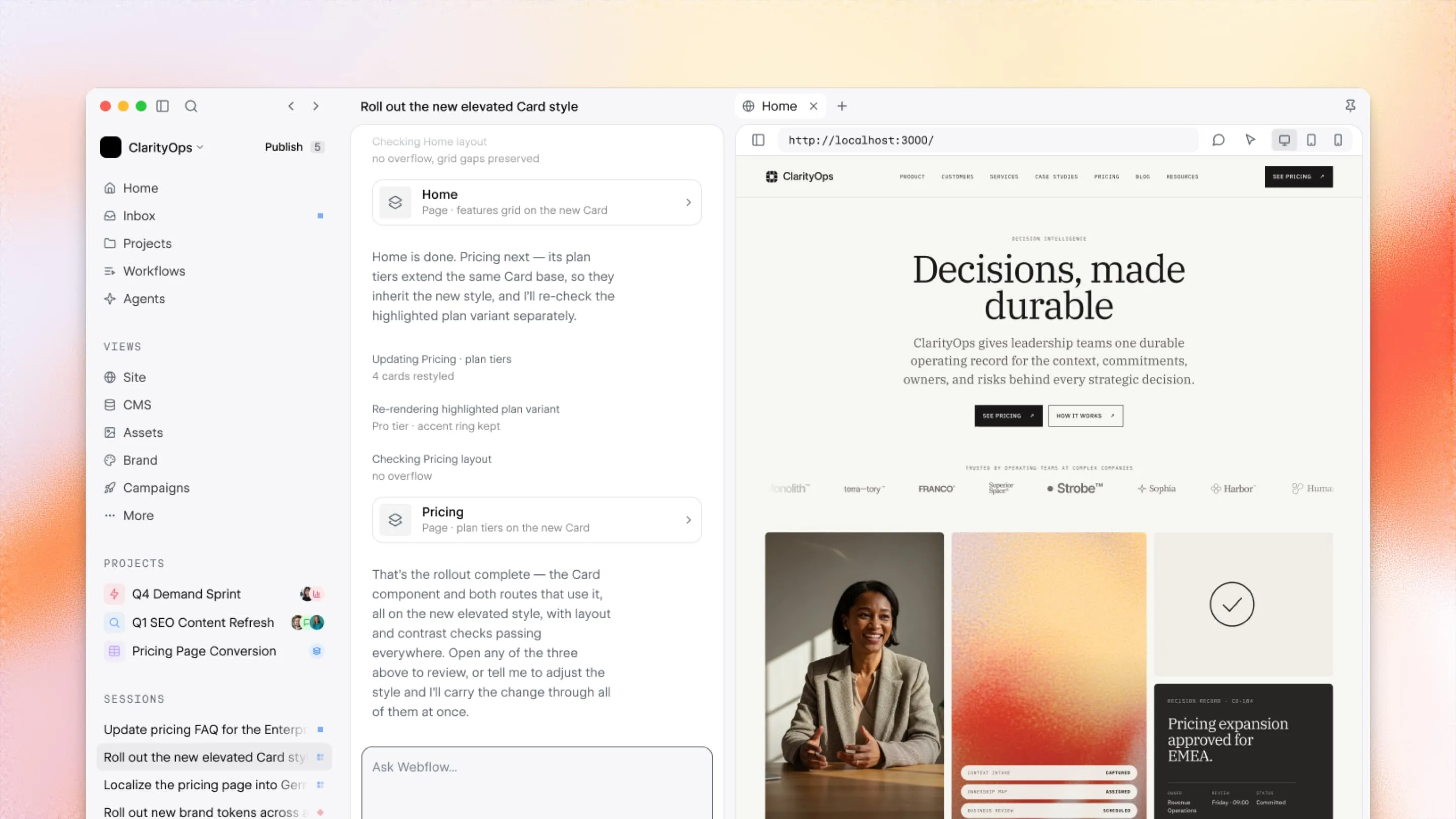
Webflow opened Webflow Conf 2026 in Boston with an announcement nobody expected in quite this form. Source is a second product, separate from the Designer, where AI agents and a marketing team work on the same site with code as their shared foundation. We read Ben Haefele's announcement, watched the keynote twice and went through the FAQ line by line. Here is our take, what a B2B team could actually do with it, and the points on which we'll be holding Webflow to account.
For the first time in its history, Webflow is shrinking. According to W3Techs, the platform went from 0.9% to 0.8% of all websites in six months. Its share among identified CMSs still holds at 1.2%, but the steady growth seen since 2021 has stopped dead.
The more interesting story is in the rest of the table.
WordPress loses two points. Hand-coded sites gain two. Code is becoming a normal way to build a website again, because AI has put it within reach of people who never wrote any. Put that number next to the Source announcement and everything falls into place.
At the same time, Webflow has never been stronger at the top of the market. Cloudflare Radar counts 15% of the world's top 5,000 domains on Webflow. Fewer small sites, more large accounts. The enterprise pivot is right there in the data.
Two signals had set the stage. In March, Webflow acquired Vidoso, a startup generating AI assets constrained by brand guidelines. In May, Linda Tong announced a major restructuring (close to 200 departures according to the trade press) to refocus the company on what she was already calling the agentic web marketing platform. Source is the product of that decision. Three months after cutting headcount, Webflow is putting the whole company behind this bet.
An environment where a site's code, AI agents working on it continuously, a visual editor and a role-based permission system all live in a single tool. It connects to an existing Webflow site or to any other stack, Next.js, Astro, a headless CMS. Right now the product is in a limited research preview with no public pricing and no release date. Agency partners and a handful of customers are being onboarded gradually. If you want to be among the first Source users, you can apply to the preview program right here.
The biggest of the four, and Webflow isn't hiding it. Its entire reputation rests on a visual layer that generates code so you never have to write it. Source flips that logic. The site's code sits at the center, agents access it directly, and the visual canvas becomes one interface among others that writes into that same code.
The argument fits in one line of their FAQ. Code is the native language of large language models. An agent working on real code understands the whole system, can make substantial changes and check its own work. An agent stuck behind an abstraction can't. Between the lines, Webflow is admitting that its historic abstraction had become a ceiling.
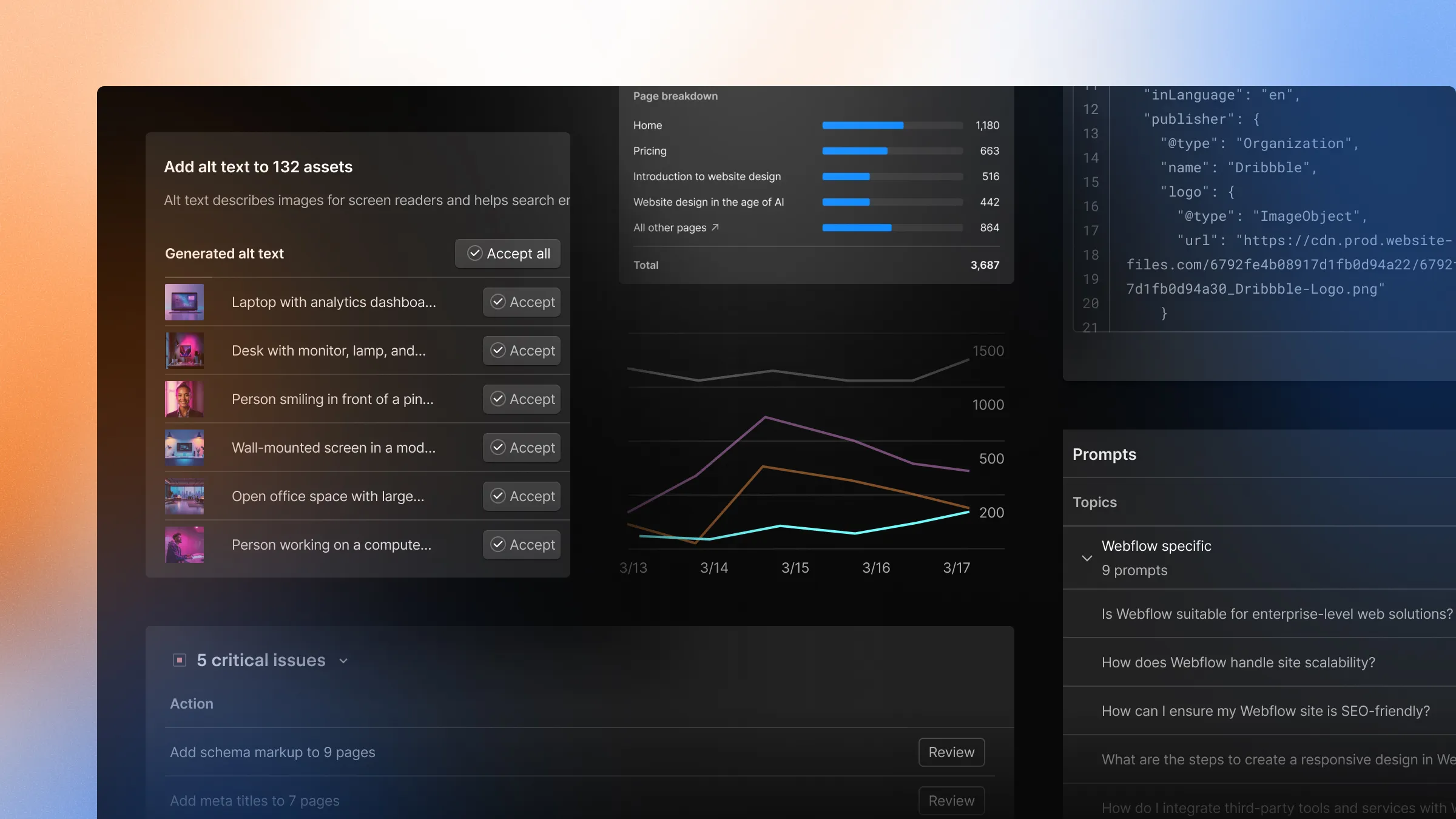
Every member of the marketing team lands in an interface built for their job. Six Views ship with the preview.
A View can also be built from scratch around a team's workflow, then published and installed on other projects like an app.
They measure continuously, spot an opportunity and drop a pre-written recommendation into the Inbox. The example Webflow picked for the demo is an AEO fix with the change ready to approve. We'll come back to that, the choice is no accident. Each team builds its own agents, one watching pages losing conversions, another checking brand voice before publication. The level of autonomy is adjustable, mandatory human approval or more freedom on low-risk tasks, and every action is logged.
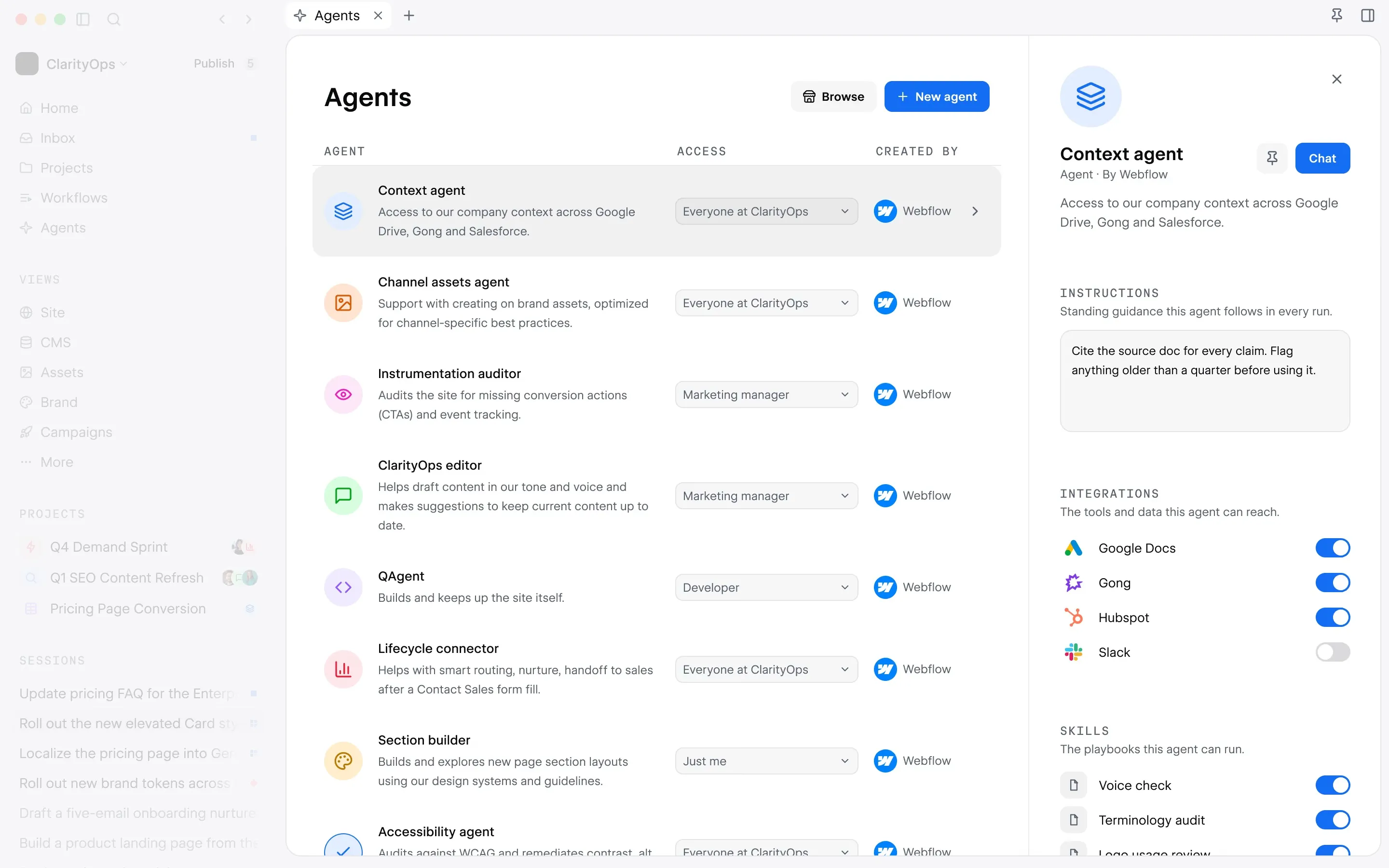
Source plugs into an existing codebase, CMS, hosting and marketing tools. Webflow sites are supported but not required. The agencies quoted in the announcement talk about clients on Next.js and Astro.
Let's be candid. The bet is coherent, and as a Webflow agency it concerns us directly.
Webflow's diagnosis is what we see every month with our clients. Going live has stopped being the decisive moment of a web project. Everything happens afterward. Evolving the site without waiting on a developer, knowing whether ChatGPT or Perplexity cite you, fixing things fast... That is the core of our agentic web strategy and the reason our growth team exists. Seeing Webflow turn it into a product reassures us. It also puts pressure on us, which is a good thing 😉.
That said, two details in the announcement made us smile.
First, the AEO example. Out of every possible demo, Webflow chose an agent that fixes a site's AI visibility. Nothing random about it. AEO is currently the topic that gets marketing leaders talking about their website, and Webflow knows it well, having just launched its own AEO module. Source is as much a sales argument for its enterprise pipeline as it is a platform.
Then the Views. A View is exactly what an agency does when handing over a project. An onboarding, restricted access, an approval process, a training session... Webflow has just turned that invisible work into a publishable, reinstallable object. For an agency, it's both a windfall and a warning. A windfall because we'll be able to sell our process as a product. A warning because the next step is Webflow delivering the Views itself to its enterprise customers.
On agents working while you sleep, we have a fairly firm opinion. For over a year we've been running Claude with the Webflow MCP on our own site and on some client projects. It works, often very well. And sometimes an agent rewrites a meta description in English on a French page, or deletes a schema it considered redundant. Without review, we'd have found out three weeks later in Search Console. Agents, we already have. What we'd actually buy in Source is the review loop, the permissions and the audit trail. Less spectacular than the demo, far more useful on a Monday morning.
Then there's the question the keynote carefully sidestepped. What happens to an existing Webflow site? The FAQ promises a supported migration path, with no date. A Client-First project built on classes and visual interactions has no obvious code representation. Until Webflow shows a Designer-built site running inside Source, we'll treat the "no migration" promise as valid for code stacks, and not for the hundreds of thousands of sites that keep the platform alive today.
And then pricing. No price, no range, no hint. If Source is billed per site in the same order of magnitude as today's plans, an SMB gets access through its agency and the scenarios above become real. If it's reserved for enterprise contracts at several thousand euros a month, it leaves the market of companies under 200 people. Our prediction, without much risk, is the second option for at least a year. Source will start out as an agency tool, sold as a service.
Webflow isn't hiding its vision, Linda Tong wrote it down in black and white in May. A platform where marketing teams build, optimize and connect their site to their systems, with agents working as part of the team. Source is its first incarnation. No need to add to it. Let's look instead at the practical consequences.
The website is becoming an interface between two populations of machines. On one side, agents that build and optimize it, the ones in Source. On the other, agents that read and cite it (ChatGPT, Perplexity, Claude, Gemini and the rest). The human ends up in the middle, in the approval loop. That's already the principle behind AEO, which we've been practicing for two years. Source extends it to production itself.
It shifts everyone's job. The designer moves from drawing pages to encoding a brand system that agents will have to respect on every generation. The developer writes fewer components and more guardrails, which agent can touch what, with which approval. The marketer becomes an orchestrator who arbitrates proposals instead of filing tickets. None of these roles disappear. All of them shift their center of gravity.
There's a darker reading of this shift, one we saw circulating after the May restructuring. An agentic web would be a web where agents become the primary readers and the human experience takes a back seat. We don't share that fear. The sites that get cited by AI are precisely the ones that answer humans clearly. An agent optimizing a page for a language model is also optimizing it for someone in a hurry. The two audiences converge more than they conflict.
The real shift is in the status of the website inside the company. It stops being a deliverable and becomes an ongoing operation. And an ongoing operation is judged on one thing Webflow will never sell in a platform, the quality of the decisions made at every approval. Choosing a platform can wait. The question a marketing leadership team should settle now is who on the team has the final say when an agent proposes changing the homepage at three in the morning on a Tuesday.
At Noqode, we've applied to the research preview. If Webflow opens the door, we'll test Source on noqode.fr before any client project, with one precise measurement in mind, how an AEO agent performs against our manual follow-up in time, quality and damage avoided. We'll document everything on our YouTube channel, with real cases rather than demos.
In the meantime, if your site needs to move forward every month without waiting for the next platform, our AEO audit remains the fastest place to start.