GEO (Generative Engine Optimization) the business opportunity window that will close in 2028

13 minutes
.
February 8, 2026

In 24 hours, Noqode ranked #1 on ChatGPT in The ranking of the best Webflow agencies in France. Not in 6 months. Not after a massive netlinking campaign. In one day.
This performance reveals a fundamental shift in B2B acquisition mechanisms. The agencies and service companies that are building their authority on LLMs today are securing positions that will be unassailable in 24 months. Those who wait are already paying the price for being late.
The reality is brutal: The GEO in 2026 is similar to the SEO of 2010. An immature market, predictable algorithms, derisory acquisition costs. In 2 years it will be over. The positions will be locked by early adopters, the algorithms will be sophisticated, and the required investment will be multiplied by 10.
Here's why this window is closing, which sectors switch first, and how Businesses that think ahead build a decisive competitive advantage !
The numbers are indisputable. The transformation of B2B buying behaviors is no longer a projection, it is a measurable reality in 2026:
This last figure validates the central hypothesis: a third of the sources cited by the AI are not those that dominate Google. A parallel battle takes place, with its own rules, its own ranking signals, its own winners.
SEO visitors don't disappear. They are migrating to LLMs. Businesses that are invisible in these responses are mechanically losing market shares. And contrary to catastrophic predictions, 95% of ChatGPT users continue to use Google (Similarweb). Cohabitation is already part of the norm.
The GEO market looks like a building under construction. In 2026, the foundations were laid but there are still places available. In 2028, the building will be finished, the apartments occupied, and buying a place will cost a fortune.
Current LLMs (GPT-5.2, Claude Opus 4.6, Gemini) use relatively basic citation algorithms. They scrape known sources, favor recent freshness, and can be quickly influenced by well-structured content. That's why Noqode was able to rank #1 in 24 hours on ChatGPT.
But this context is temporary. By 2028, LLM algorithms will be radically more sophisticated. They will integrate real-time scraping, cross-source sentiment analysis, and detailed detection of historical authority. They will no longer just crawl the last published article. They will analyze the global fingerprint over 3 years, editorial consistency, and recurring mentions in third-party sources.
In 2010, premium domain names sold for a few thousand euros. Businesses that understood the challenge secured their digital presence at a fraction of the current cost. Those who waited are now paying fortunes to buy their own brand name, squatted by cybersquatters.
The GEO is exactly the same moment. Except that this time, they are not domain names to be secured. These are positions in the spirit of artificial intelligences. Positions that competitors will occupy.
Right now, LLMs are ingesting content, classifying sources, learning who is authoritative about what. Every day that goes by without a GEO strategy is a day when competitors are building their lead. And unlike SEO where catching up was possible with a budget, GEO rewards seniority, freshness and structure.
On December 2025, Noqode put online an article structured according to the AEO framework. Title: “Top 4 Webflow agencies in France [2026 comparison]”.
The next day, ChatGPT listed Noqode in first place. Three days later, in the lead. Today, Noqode appears in 90% of ChatGPT requests linked to French Webflow agencies.
This result is the result of a precise methodology developed after analyzing more than 50 target queries and refining the optimization strategy for LLMs. Here are the 4 pillars of the approach:
The business results are unquestionable. Since positioning #1 on ChatGPT, Noqode has signed Maison de Lysenne and Odoné, two customers who explicitly mentioned having discovered the agency through a search on ChatGPT. Not on Google. On ChatGPT.
These leads are different. They arrive better informed, with a clear understanding of the expertise, often already convinced. The sales cycle is shortened. The closing rate is higher. The perceived value is higher.
But here's the crux of the matter : this ease of positioning is temporary. In 2026, a well-structured fresh item can still make a difference in 24 hours. In 2028, this same article will be drowned in a sea of GEO optimized content, and LLMs will favor brands that have appeared in their indexes for years.
The authority built today is worth its weight in gold. Every mention, every citation, every appearance in an LLM in 2026 builds credibility for 2028. Impossible to buy back 3 years of history. They have to be built, day after day.
A classic SEO lead follows a fragmented path: type “webflow agency”, clicks on a site, compares three tabs, leaves again, comes back two days later, reads an article, maybe subscribes to a newsletter. The journey is uncertain, long.
A GEO lead follows a qualified path: ask ChatGPT “Which Webflow agency to choose for a consulting firm site with a strong SEO need?”. ChatGPT answers by quoting Noqode, explains why, mentions the specificities. The prospect arrives on the site with a qualified intention, a perception of authority already built up.
The difference is fundamental. SEO is about competition. The GEO makes recommendations. In a B2B context where trust is the first obstacle to buying, this nuance changes everything.
The numbers at Noqode:
This difference in quality is explained by the very positioning of the recommendation. When a company is listed by ChatGPT in a specific context, it benefits from an immediate transfer of authority. The prospect does not discover an option among 10 Google results. He receives a well-founded recommendation.
The GEO is not suitable SEO. It is a discipline in its own right, with its own rules, its own ranking signals.
According to the August 2025 Ahrefs study of thousands of queries, here is what the data on influencing factors reveals:
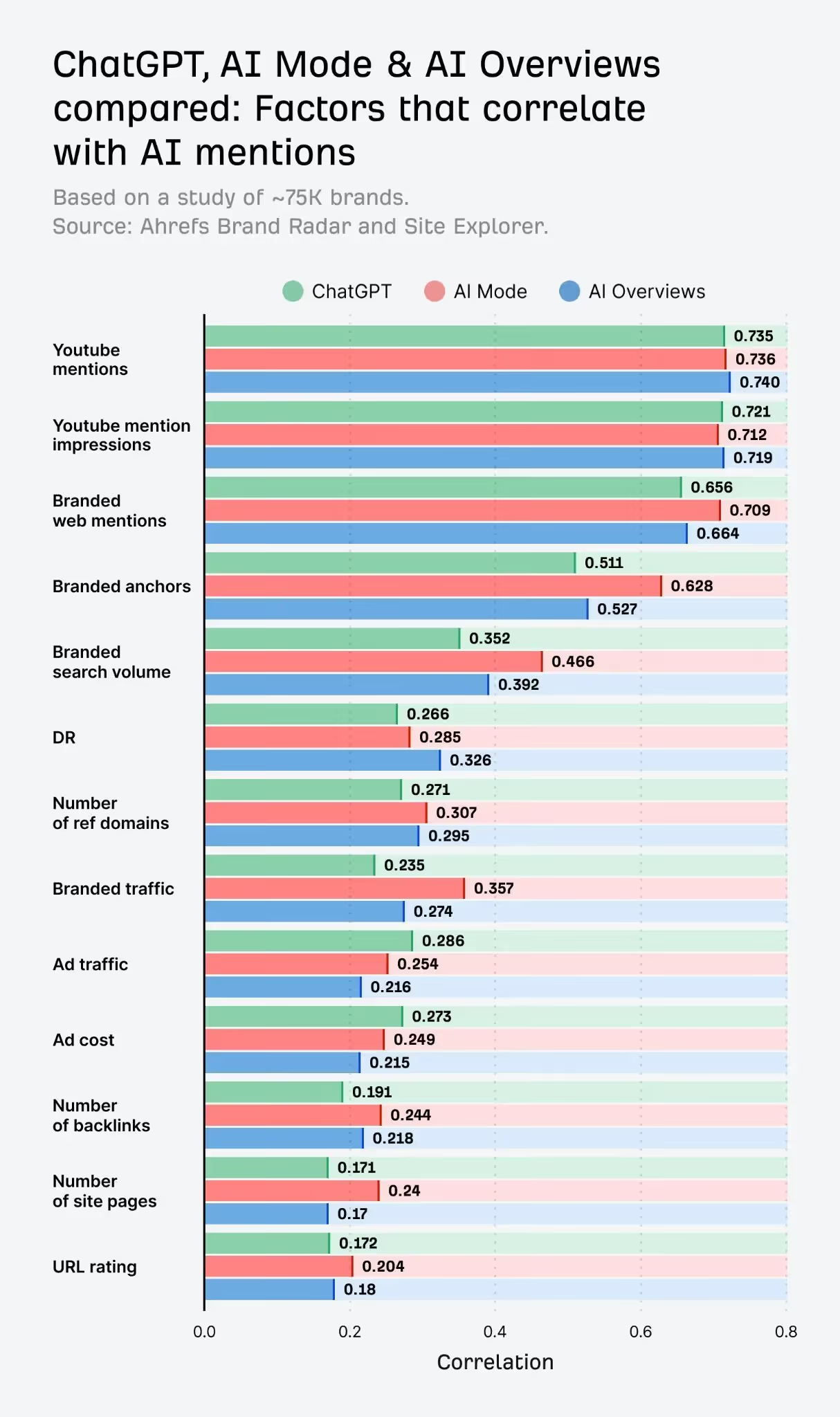
GEO ranking signals validated by research:
The number that changes everything: only 12% of the URLs cited by ChatGPT, Perplexity and Copilot rank in the Google top 10. This means that 88% of the sources cited by LLMs are not the ones that dominate traditional SERPs.
Years and considerable budgets have been invested in netlinking. It is legitimate. But to think that this strategy protects in the LLM era is a mistake. The rules have changed. Trust signals as well.
To deepen these mechanisms, the guide on How AI and ChatGPT are transforming the web details the structural changes that are taking place.
Projection in 2028. A B2B company manager types his sector of activity on ChatGPT. Three brands always appear in the responses.
They are not necessarily:
But they have:
A new business arrives. Good site. Good product. But ChatGPT does not cite it. No history. No investment the previous 3 years. Wait for the GEO to be “mature” to launch.
Now, we need to make up for 3 years of delay. Convincing sophisticated algorithms of legitimacy. Multiply the mentions, the contents, the signals of authority. Invest 10x more than those who anticipated.
This dynamic has already been observed with SEO. Brands that invested early (2010-2015) built positions that were almost unassailable. Those who waited are now paying a fortune in netlinking, content, technical optimization, to gain a few places.
The GEO follows the same dynamic. Except the window is even shorter. LLMs are evolving faster than Google. Adoption is faster. Barriers to entry are going to be built up more quickly.
Sectors already impacted in 2026:
Sectors that will change in 2027-2028:
Why this acceleration?
The democratization of LLMs followed the same curve as the adoption of smartphones between 2010 and 2015. Once a tool becomes indispensable in daily life, its professional use explodes. ChatGPT has passed the 800 million weekly active users mark.
B2B decision-makers who use ChatGPT to write their emails in the morning use ChatGPT to search for a provider in the afternoon. It's mechanical. It is unavoidable. And with 89% of B2B buyers already using AI in their buying process, the changeover is already under way.
For B2B businesses, consulting firms, agencies, service companies, two options:
Option 1: wait
Wait for the GEO to be “mature.” Wait for competitors to take positions. Wait for prospects to ask why the business isn't on ChatGPT. Wait for the acquisition cost to explode because buying back visibility will be necessary.
Option 2: take action
Concrete action plan for the next 90 days:
At Noqode, the systematic integration of a GEO layer in each web project delivered is not a trend. It is a decision based on measured results, customers signed thanks to this approach, and the certainty that in 18 months, customers will thank for having anticipated.
Our expertise has made it possible to develop a comprehensive GEO methodology, tested on more than 50 queries and validated by concrete business results.
The question is not whether GEO will become essential. The question is whether businesses will be positioned when prospects start looking.
The land grab has begun. While some are thinking, others are securing their territory. While some are waiting for evidence, others are building their authority. While some are hesitating, the window is closed.
In 2 years, two categories: those who anticipated, and those who should have listened.
Noqode supports B2B companies in their SEO/GEO strategy. To know where your business is at and how to position yourself before the window closes, contact us.