


Context
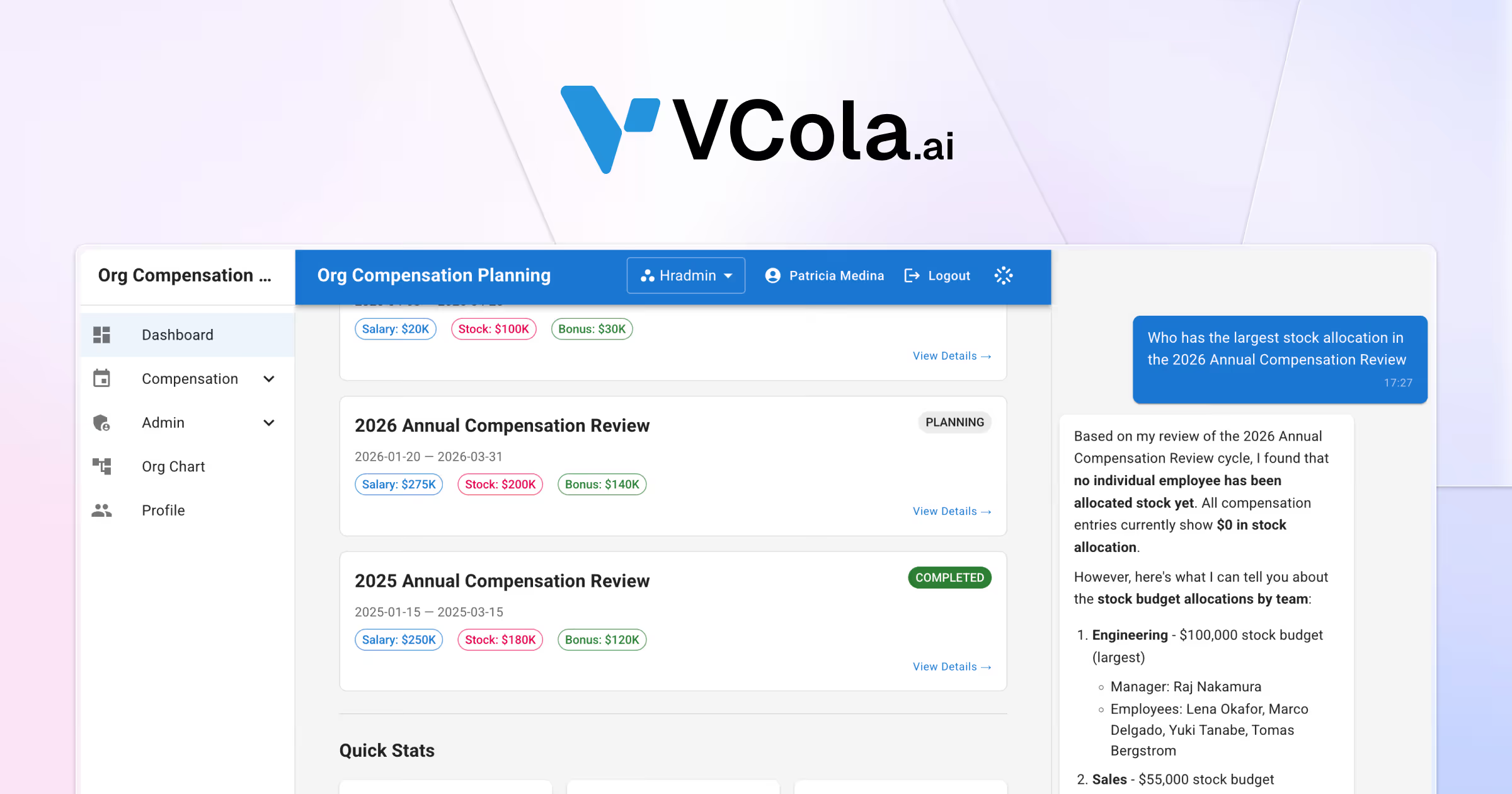
VCola is a Dublin-based AI enterprise platform, founded by three former Workday executives: David Clarke (ex-CTO and SVP Workday, Venture Partner at Frontline Ventures), Annrai O'Toole (ex-European GM Workday, Founder CTO of IONA Technologies, CEO of Utmost) and Kashif Qayyum (Ex-Workday Fellow). Three profiles who spent more than twenty years building SaaS ERPs used by multinationals before asking themselves a simple question: what should an ERP built for the AI era look like.
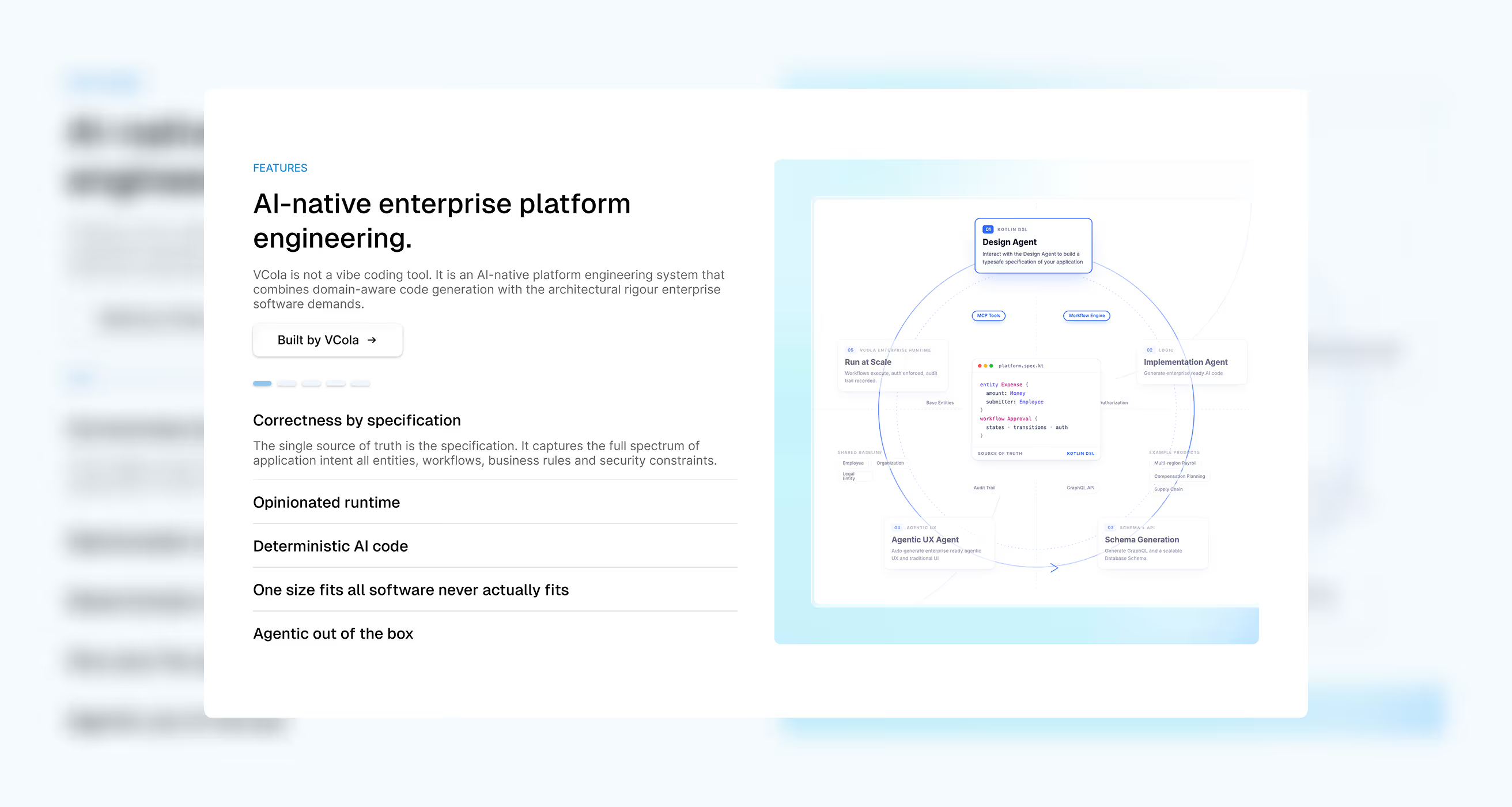
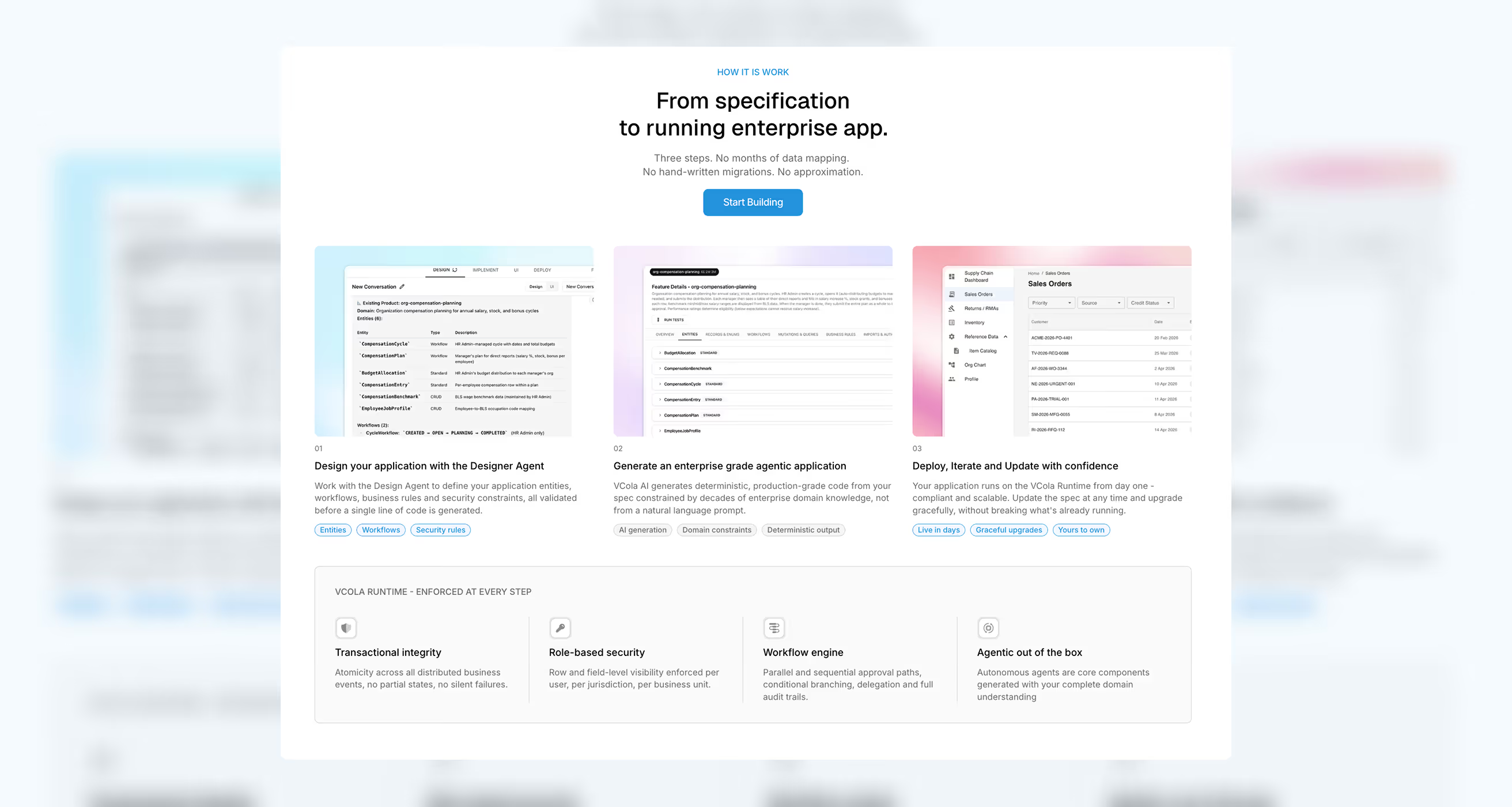
Their answer is in one line. Where vibe coding tools like Lovable, Bolt.new or Cursor stop at the prototype, their platform generates code Enterprise-grade based on a formal specification, with transactional integrity, role-based security and the ability to upgrade over time. Product tagline: Custom by design.
When Caroline O'Reilly (COO of VCola) contacted us in April 2026, the product existed but the image did not yet exist. No logo, no site, no formalized positioning, no visual identity. A blank sheet of paper to carry a product whose target is composed of CTOs, CIOs and CFOs of major accounts accustomed to the visual standards of Workday, SAP or Oracle.
La time constraint was asked at the outset by Caroline: everything had to be delivered before the end of April, perfect timing with the launch of the early adopter program. Three weeks to build a brand, a design system, a complete site and the entire underlying technical infrastructure. No margin.

“Honestly, I never give 5 stars to anyone, but honestly, I think you deserve it. I have never met such a responsive and collaborative team. A real pleasure to work with you, really.”
Issues
The first challenge was the company credibility. When a buyer has increased Workday contracts to seven figures for ten years, their visual tolerance is lifted. Any site that looks like yet another generic AI tool (fluorescent gradients, robot illustrations, vibe coding aesthetics) immediately disqualifies the product. The brand needed to be able to stand up to a Workday brand book without mismatching, while maintaining its own identity. No mimicry, no genericity.
Second, the product is technically dense. Formal specification, opinionated runtime, deterministic code, deterministic code, role-based data access, transactional integrity, agentic layer: all concepts that repel a hurried buyer if the copy does not make them readable immediately. The structure of the site had to carry this complexity without being subjected to it, with a typographical hierarchy designed for long technical paragraphs.
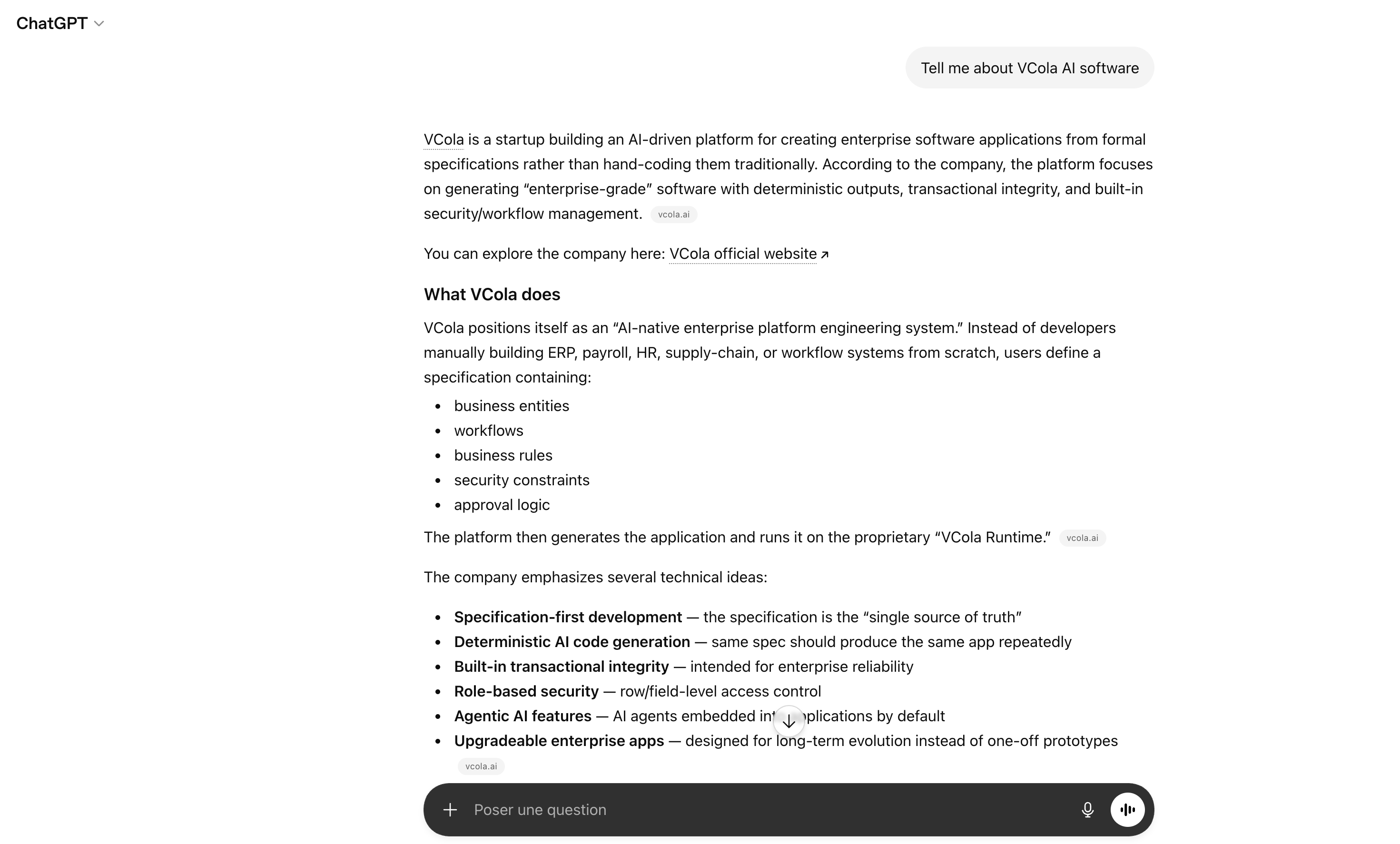
Thirdly, The audience questions LLMs before Google. The brief was explicit: “the first user of this website is an LLM.” The site had to be citable by AI response engines, not just referenced on Google. This required a AEO architecture complete: native llms.txt file, enriched schema.org, enriched schema.org, snippet-ready paragraphs, meta descriptions built as direct responses to proprietary vocabulary (Agentic ERP, specification-first generation, VCola Runtime, VSL specification).
Fourth, thetechnical infrastructure under the hood. Three active forms (Early Adopter Signup, Contact, Newsletter Demo Gateway) had to push their submissions to Google Sheets for the sales team, with clean transactional emailing, anti-bot, and strict Irish GDPR compliance. No hard Zapier, no critical third-party dependencies. A controlled stack, which can then be transferred to VCola's internal dev.
Finally, the deadline constraint. Three weeks to deliver a complete brand, a design system, eight Webflow pages, a CMS, seven collections and the associated form infrastructure. The constraint was wanted by Caroline to align go-live with the launch of the early adopter program. No margin for long iterations or unstructured back and forth.
Objectives
Four objectives structured the project.
An ownable and enterprise-ready visual identity, created from scratch
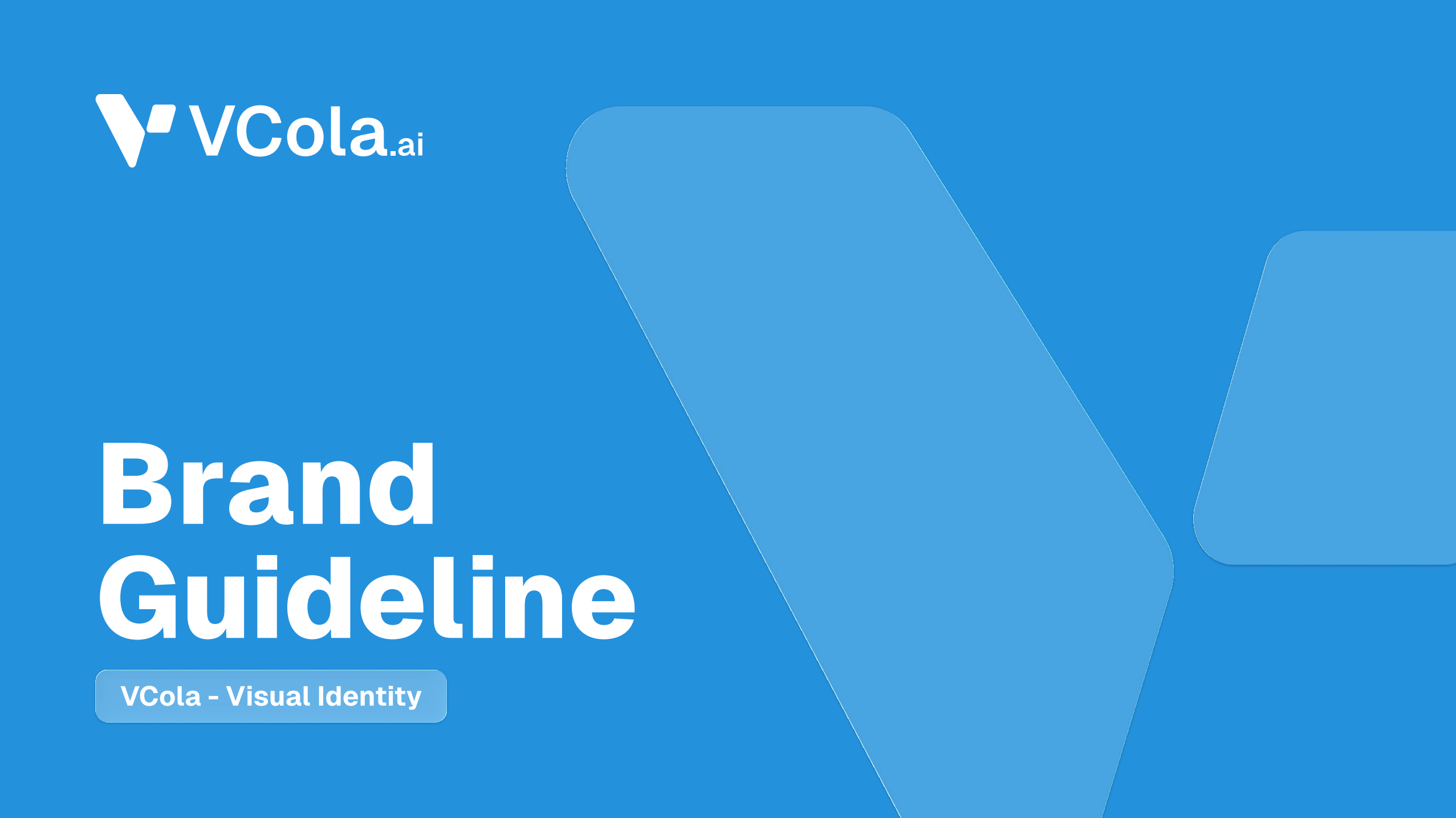
Logo, logo motion design, color palette, typographic system, custom iconography, comprehensive brand book. The artistic direction deliberately moves away from 'vibe coding' aesthetics (fluorescent gradients, robotic illustrations, consumer-tool look) to align with enterprise visual standards set by Workday, Snowflake, or Databricks. Decisive sobriety, expertly handled dark mode, zero superfluous decorative elements. The goal: for a key account CTO to open the site and immediately recognize a serious player, without needing to read a single line.
A comprehensive Figma design system and a premium Webflow site
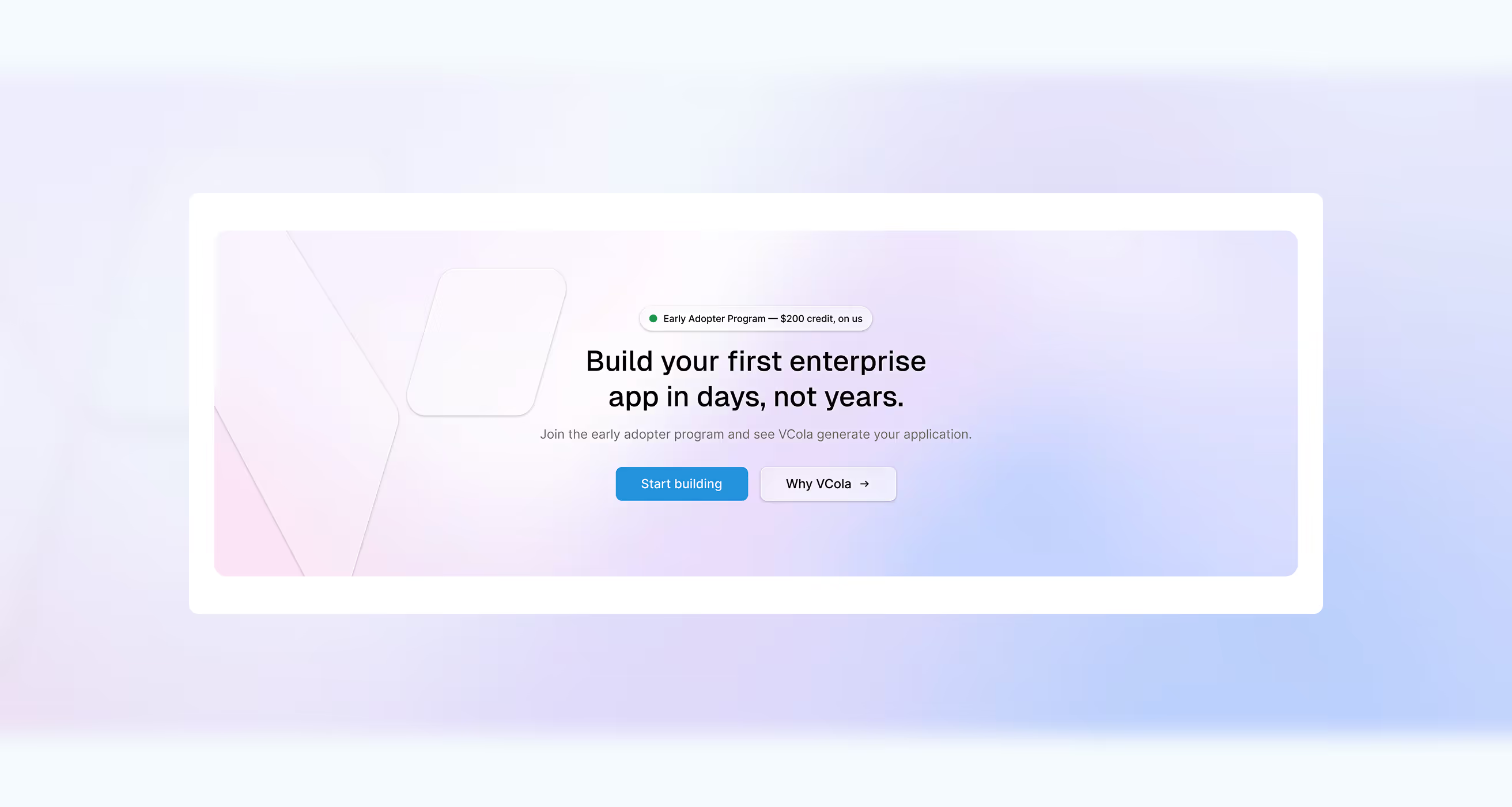
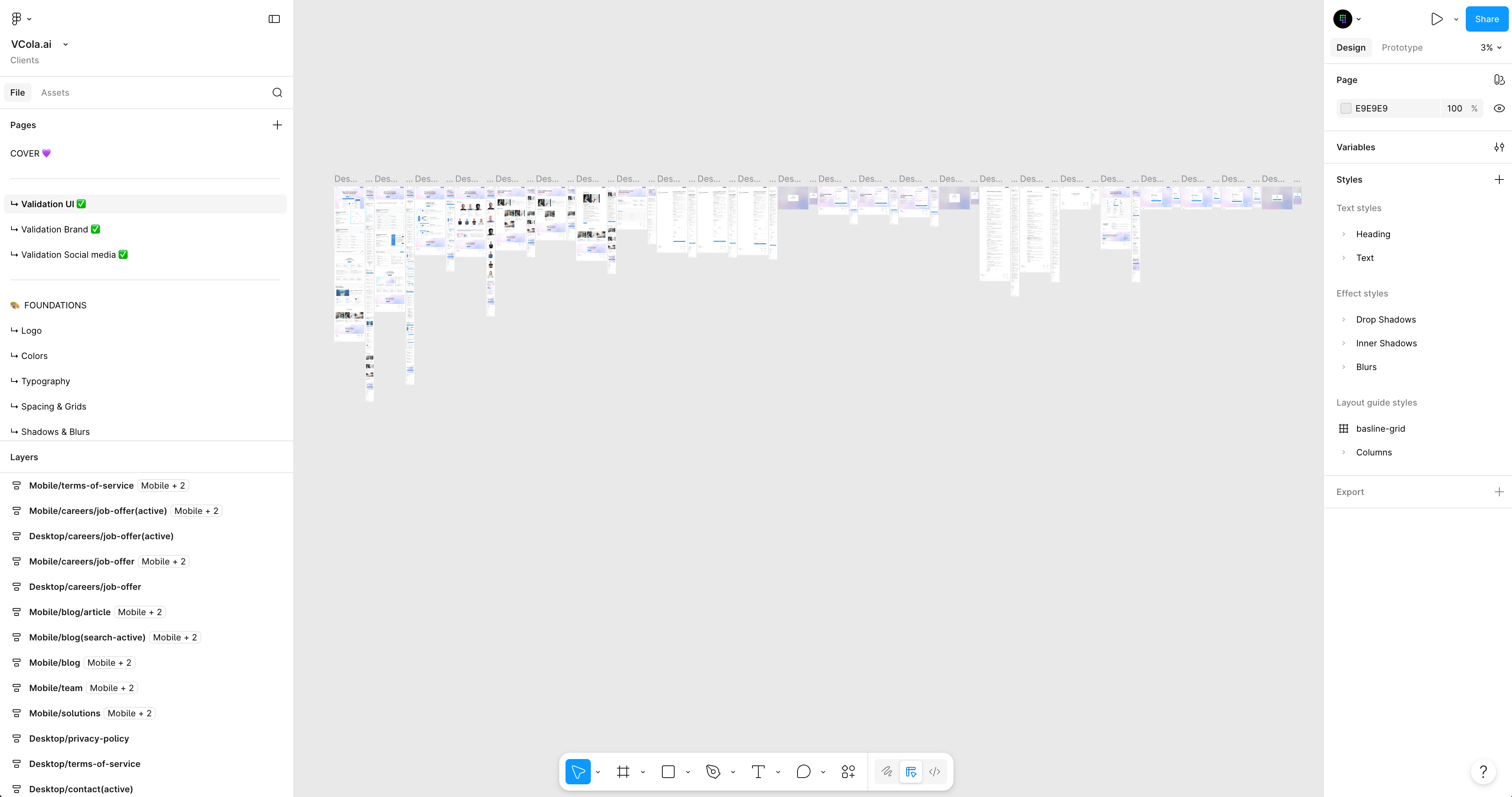
Seven pages initially planned (Home, Why VCola, Solutions, Founding Team, Blog CMS, Early Adopter Signup, Careers), expanded to eight with the addition of a Pricing page during the project and a Demo Gateway Page post-delivery. Each page designed as a precise answer to a business question, with UX/UI capable of conveying enterprise rigor without visual rigidity. The Figma design system was built upstream of the wireframing (color variables, text styles, spacing system, reusable components) to ensure perfect consistency between pages and industrialize development on Rayane's side. This foundation is now reusable for all future assets: white papers, investor decks, LinkedIn banners, product presentations.
A native AEO strategy from launch
Comprehensive llms.txt file with absolute URLs, structured product description, technical FAQs, and proprietary vocabulary (Agentic ERP, specification-first generation, VCola Runtime, VSL specification). Schema.org Organization, Product, and FAQPage integrated into custom code. Meta titles and descriptions formulated as direct answers, without em dashes, to maximize citation chances by ChatGPT, Perplexity, Claude, and Google AI Overviews. Alt text for all visuals written to provide both accessibility and semantic context. Search Console configured upon launch to ensure immediate GSC tracking and identify initial AI citations.
Advanced technical infrastructure, beyond standard Webflow
Transactional emailing via Resend to ensure deliverability and avoid spam filters: critical for enterprise leads that must never get lost in a junk mail folder. Anti-bot via Cloudflare Turnstile on the three active forms (Early Adopter Signup, Contact, Newsletter Demo Gateway), more precise than reCAPTCHA and without user friction. Custom Cloudflare Worker pipeline to push submissions to Google Sheets in real-time, with a dedicated service account and server-side secured credentials. A controlled, documented, and transferable stack to VCola's internal dev team to give them full ownership of the server configuration.
This requirement summarizes our approach to Webflow site for SaaS, where the interface must signal product maturity and convince a key account decision-maker from the first impression.
Solutions
Noqode has deployed an approach Brand · Build · AEO, orchestrated over three weeks with Anthony Le Henaff (art director, Noqode partner), Rayane Ali (lead web developer, Noqode partner) and Amaury de Luca (strategy) covering coordination, copywriting and AEO deployment.
The method was based on a systematic parallelization construction sites. As soon as the DA was validated, Webflow development started on the first models while the following ones were finalized. A dedicated WhatsApp group allowed quick points with Caroline in Dublin, which made it possible to avoid any waiting period related to sequential validations.
A brand research phase that is primarily visual deliverable
The first week was devoted to a research phase structured before producing any final element: visual audit of enterprise references (Workday, Snowflake, Databricks) to identify expected codes, reverse audit of pitfalls to avoid (Lovable, Bolt.new, Cursor and the vibe coding aesthetic that immediately disqualifies a major buyer), typographic exploration and chromatic positioning tests.
From this initial work emerged an artistic direction. Deliberately light mode, in contrast to the systematic dark mode of consumer AI tools, requested by Caroline as early as the brief. Primary blue #2592DE like cornerstone, translucent gradients animated in the background, effect Liquid Glass on key surfaces. An aesthetic that conveys technical precision and accessibility without falling into AI stereotypes. Art direction validated in two iterations, then locked as the basis for all downstream deliverables.
A Figma design system designed for Webflow development
The design system was built with production logic in mind, around four pillars:
- Palette on a scale of 50 to 900 on primary blue and neutrals
- Geist (Vercel) for headings and displays, in Medium 500
- Inter for the body and the UI, on four weights
- Figma components in variants, which reflect the logic of Webflow components
Each Figma component corresponds to a Webflow component, each Figma variable to a Webflow variable. The Handover design-development was done without friction, which freed up time for fine optimizations at the end of the project: animations, micro-interactions, responsive polish.
A Webflow Business development started by the CMS
The construction of the site began with the structuring of CMS collections Before the pages were attacked. This approach avoids CMS restarts at the end of the project, which are very expensive and expensive on complex sites. The dynamic pages (Blog, Founding Team, Solutions, Careers) were then developed directly on operational collections, with real data. The development was done on the Noqode agency workspace, then transferred to the Caroline workspace on the client side once the recipe was validated.
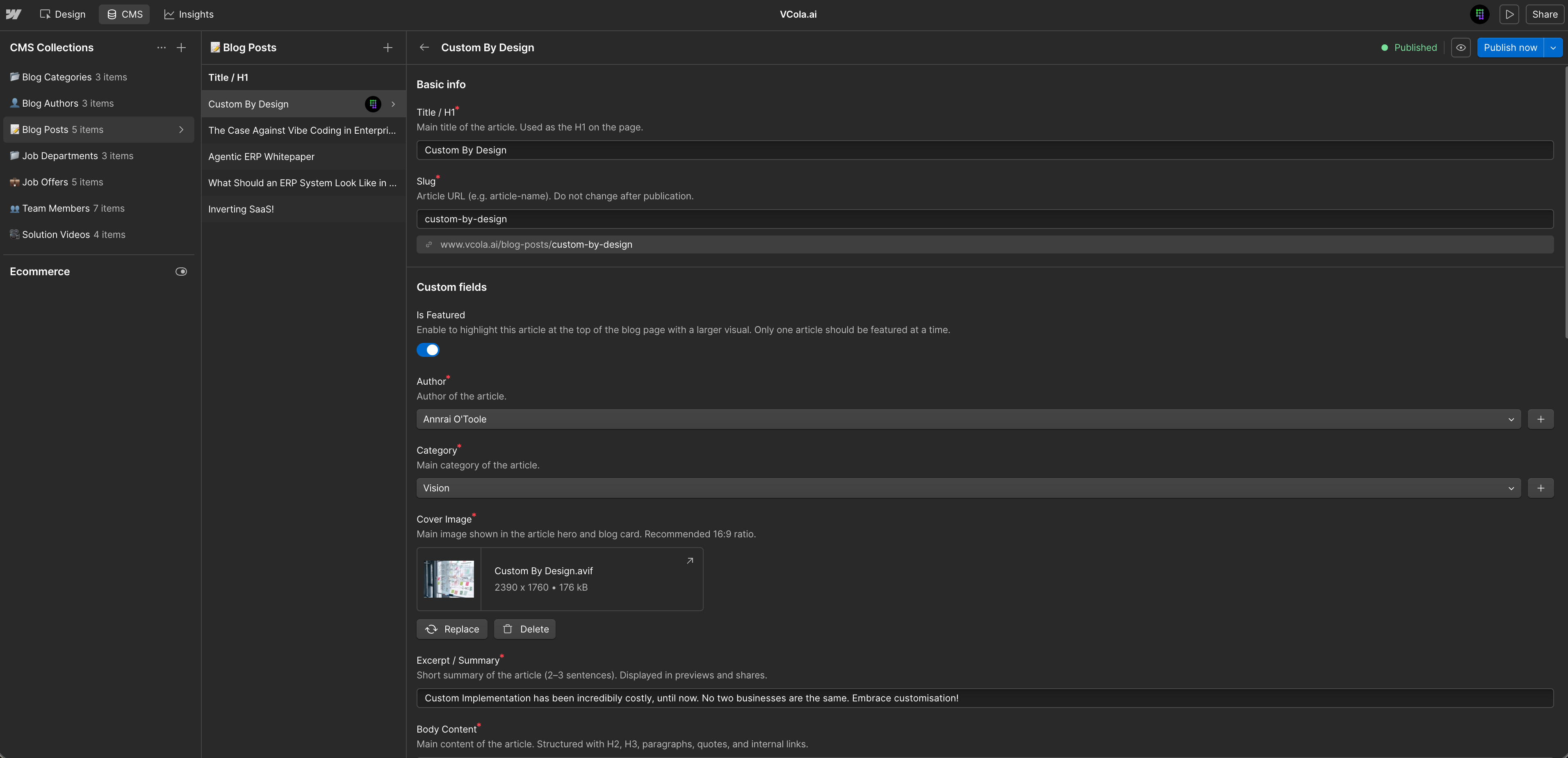
Seven collections were defined, with their fields, their educational help texts and their relationships:
- Blog posts (title, summary, body, author, author, author, author, author, category, category, related posts, featured image)
- Blog Categories (Product, Vision, White Papers)
- Blog Authors with dynamic profile page and auto-populated articles
- Job Offers With PDF application upload
- Job Departments (Engineering, Product, Go-to-Market)
- Team Members For the Dynamic Founding Team Page
- Solutions for the 4 product cards (International Payroll, HCM, Equipment Request, Supply Chain)
A custom technical infrastructure, excluding native Webflow functionalities
The native Webflow functionalities did not cover the expected level on three critical points: deliverability of transactional emails, anti-bot robustness, direct integration with commercial tools. Noqode has deployed a Stack Custom Around three distinct bricks.
Transactional emailing via Resend's Email API
All submission notifications go through Resend rather than the native Webflow mailing. Deliverability is significantly higher thanks to clean SPF/DKIM/DMARC authentication, the templates are customizable and the journaling of shipments is complete. A critical choice for enterprise leads whose loss is due.
Anti-bot via Cloudflare Turnstile
The three active forms (Early Adopter Signup, Contact, Newsletter Demo Gateway) are protected by Turnstile. The solution offers a Higher accuracy than reCAPTCHA, without visible user friction and with native GDPR compliance. Zero spam received from go-live.
Cloudflare Worker to Google Sheets pipeline
A Cloudflare Worker receives the submissions and pushes them in real time into a Google Sheets sheet from the sales team, via a dedicated service account. Credentials stored in variable environments on the Worker side, never exposed client-side. A plan B with Make.com has been documented in case of future migration, and Cloudflare DNS is set up in DNS only mode to avoid conflicts with Webflow hosting.
AEO strategy and native schema.org
AEO Optimization has been deployed paralleled of development, and not in post-delivery correction. Meta titles and descriptions formulated without framing hyphens, with a direct response format favored by AI engines. Alt text for all visuals written to carry both accessibility and semantic context. Search Console set up as soon as it goes live to identify the first quotes.
On the machine-readable side, two deliverables structure indexing by LLMs:
- One llms.txt file with absolute URLs, product description, proprietary vocabulary (Agentic ERP, specification-first generation, VCola Runtime, VSL specification), technical FAQ and main sitemap
- One schema.org complete (Organization, Product, FaqPage) integrated into the custom code
The placeholder content of Job Offers was purposely excluded from the llms.txt to avoid polluting future AI quotations.
Irish GDPR compliance
GDPR compliant cookie banner integrated before being put online via Cookiebot, a non-negotiable agreement for a Dublin-based company. The Choice of Cookiebot was made for Anticipate the future integration of third-party tools (Google Analytics, marketing scripts, advertising pixels) with consent management that is already industrialized and compliant. Terms of Service and Privacy Policy pages delivered and linked in the footer.
Impact/Results
Cola went from one in three weeks Blank Page To a complete, operational online presence in line with the standards of its target audience. The result is not only a site, but a Growth Platform Which the team can now rely on without technical constraints.
A brand that won't ask to be redone for a long time
The Visual Identity Posed with Anthony Works On All supports That VCola will activate in the next twelve months: site, brand book, LinkedIn banners, white papers, investor decks, future product materials. The Figma design system is versioned, documented and reusable. No brand re-work is expected before a major strategic step (change of positioning, Series A raise, geographic expansion).
Total Editorial Autonomy on the Caroline Side
Perhaps that is the most important thing. Before the project, VCola had nothing to publish anywhere. After Delivery, Caroline Can Manage All Content Alone : blog posts, job offers, team members, solution demo videos, static page updates. Zero technical dependence for the editorial roadmap.
To make this autonomy real and sustainable, two support deliverables have been produced:
- One Video conferencing training session Dedicated with Caroline, covering Editor mode, Designer in Preview Role, CMS and publishing best practices
- The Website Management Guide, a 30-page document structured in three parts (Roles & Access, CMS Collections, AEO & Quick Reference), with step-by-step procedures, golden rules and summary sheets per collection
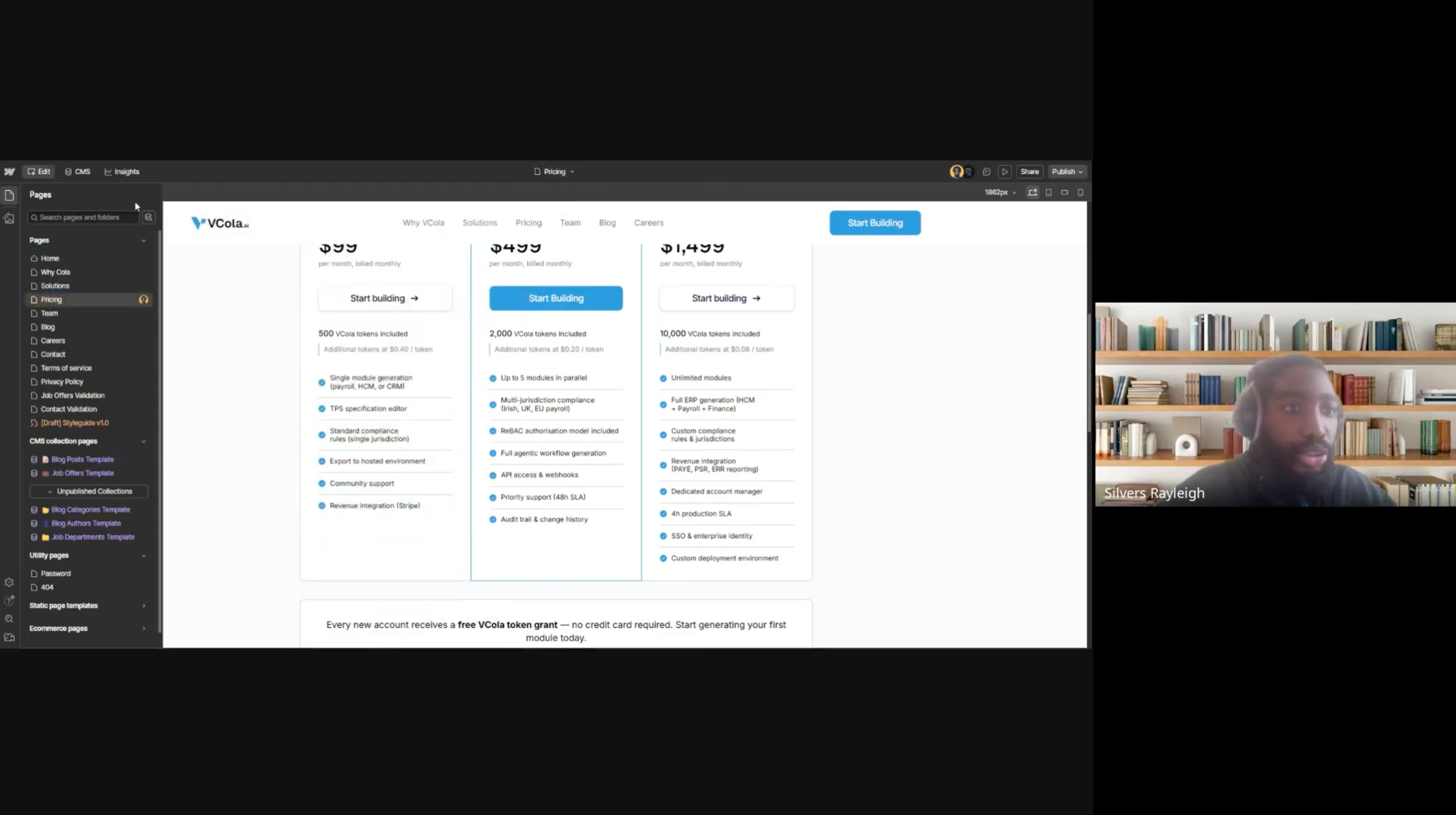
Caroline now has reference documentation that she can reopen at any time, and direct contact for cases not covered.
A Technical Infrastructure That Lasts Without Intervention
The entire custom stack (Resend, Cloudflare Turnstile, Cloudflare Worker, Cookiebot) is running in production Without Incident Since the Go-Live. Early Adopter leads arrive in real time in the sales team's Google Sheets sheet, email authentication is clean, spam is non-existent. The Worker is documented to be transferred to Sean (VCola internal dev), which will eventually give the Full Ownership From the server configuration to the team.
A site ready to be cited by LLMs from day 1
The AEO strategy deployed in parallel with the dev positions VCola to be cited by AI engines on two levels of queries: the Proprietary Queries (Agentic ERP, specification-first generation) that vCola wants to own, and the Sector Queries (AI-native enterprise platform, enterprise-grade AI code generation) more competitive. The structured llms.txt, the enriched schema.org and the Search Console configured as soon as it went live maximize the chances of being cited by ChatGPT, Perplexity, Perplexity, Perplexity, Claude and Google AI Overviews from the initial indexing.
A Delivery That Met The Time Constraint Without Compromise
The Project Was Delivered On April 29, 2026, largely within the deadlines set by Caroline. The three-week constraint, originally intended to align the go-live with the launch of the early adopter program, was met without compromising on quality or scope, with even Two pages added along the way (Pricing then Demo Gateway). NPS of 10/10 and maximum score on all post-delivery evaluation criteria.