
AI
Claude Code
Claude Code is Anthropic's coding agent. It reads a codebase, runs commands, edits files and handles Git in plain language, from the terminal, the IDE, the web or mobile. It is included in Claude subscriptions from the Pro plan.
Claude Code is Anthropic's coding agent. It reads a codebase, runs commands, edits files and handles Git in plain language, from the terminal, the IDE, the web or mobile. It is included in Claude subscriptions from the Pro plan.
Claude Code is Anthropic's coding agent. It works directly inside the project: it reads the codebase, runs commands, edits files and handles Git commits, on a simple request in plain language. Our team uses it in production to build, audit and migrate Webflow sites. This page sums up how it works, what it costs and what we get out of it every day.
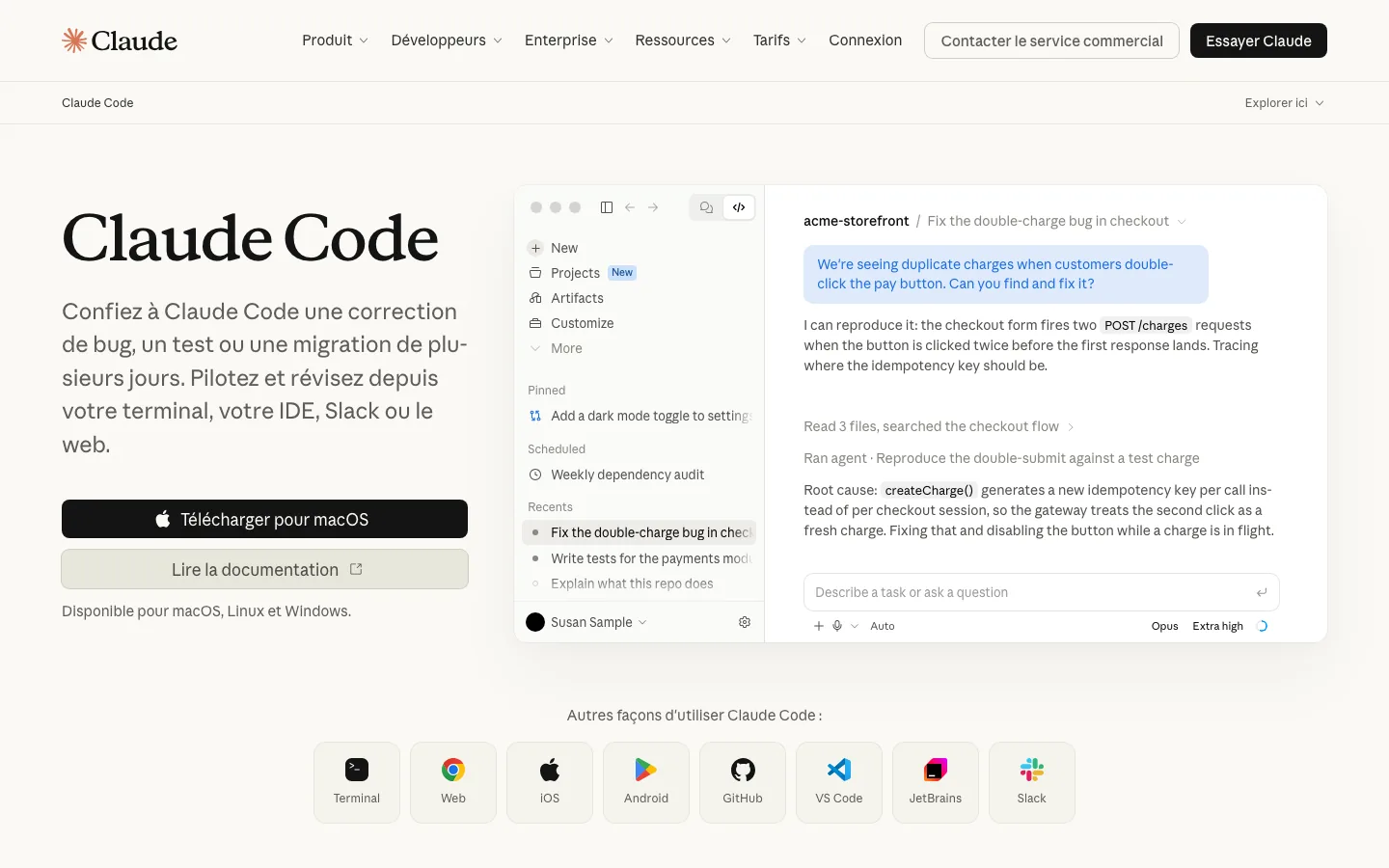
Anthropic introduced Claude Code on 24 February 2025 as a research preview, alongside Claude 3.7 Sonnet. The tool became generally available on 22 May 2025, with the Claude 4 generation. Since 22 September 2026, Claude Opus 5.5 is its default model on the Pro and standard Team plans.
Claude Code is no longer limited to the terminal. The official Claude Code page offers it on macOS, Linux and Windows, as a desktop app, on the web, on iOS and Android, and as an extension for VS Code, JetBrains, Slack and GitHub. The terminal remains the most complete surface.
On startup, Claude Code indexes the project and reads the CLAUDE.md file, where the team describes its stack, conventions and testing rules. It then proposes a plan, asks for permission before each edit and each command, and executes.
The agent also connects to MCP servers. A connector added in Claude Desktop, such as Mobbin's, is picked up by Claude Code with no extra setup. Skills and plugins sync from the claude.ai account.
Our team runs on two Max subscriptions, one of them dedicated to development. Claude Code handles the repetitive, high-volume tasks.
We also pitted Claude Fable 5.1, in Claude Code, against GPT-6 Astra, in Codex, on building the same website, first without and then with Mobbin references.
The result (video in French) confirms a lesson we see on every project. The prompt and the context weigh more than the choice of model. Our article on Claude Opus 5.5 and the Mobbin MCP details the method on a full neobank website.
Claude Code has no separate subscription. It is included in paid Claude plans, taken from the Claude pricing page on 23 October 2026.
| Plan | Price | What you get |
|---|---|---|
| Free | $0 | No access to Claude Code |
| Pro | $17 a month billed yearly or $20 monthly | Claude Code included, with usage limits suited to regular development |
| Max | From $100 a month | Five or twenty times Pro usage, for long sessions |
| Team | $20 per seat per month billed yearly or $25 monthly | Standard seats for teams of 2 to 150 people, premium seats for heavy use |
| API | Pay as you go | Billed by token usage, depending on the model |
Both use the Webflow APIs, for different audiences. Claude Code requires an installation and a technical profile. It works on local files, Git repositories and full codebases. The Webflow connector is enabled in two clicks from Claude, with no setup, to manage the CMS, pages and metadata. Our guide to the Claude and Webflow connector covers that second use, designed for marketing teams.
Claude Code has changed the way we produce. Long, repetitive tasks now fit into a supervised session. We keep control of architecture and review. The agent moves forward in small, approved steps, guided by a precise CLAUDE.md.
Our AI and automation services set up these workflows for teams that want the benefits without building them alone.
No. Claude Code requires a paid Claude subscription, from the Pro plan at $17 a month billed yearly, or an API key billed by usage. The free plan does not include it.
Claude Code is built by Anthropic, the American company that develops the Claude models.
To get a reliable result, yes. The agent writes the code, but someone has to frame the request, understand the changes and approve what goes to production.
None wins on every task. Opus 5.5 leads several coding benchmarks published by Anthropic, and GPT-6 Astra led WebDev Arena in September 2026. The context you provide and your working method matter more than the model.
Yes, through the Webflow API or Webflow's MCP server. For a non-technical team, the Webflow connector in the Claude app is simpler to use.
We help you scope, build and grow your project.
Three tools close to this one, selected by our team.
End of the page, start of the project
30 minutes with an expert to scope the project, the budget and the next steps.