Oops! Something went wrong while submitting the form.
🍪 Cookie settings
By clicking “Accept all”, you agree to the storing of cookies on your device to enhance site navigation, analyze site usage, and assist in our marketing efforts. See ourPrivacy Policy for more information.
Next.js is an open-source framework built on React and developed by Vercel. It handles server-side rendering, routing, data fetching and image optimisation. It is used to build web apps and websites that mix content and interactive features.
35% of Next.js sites pass Core Web Vitals, according to HTTP Archive data cited by Astro.
Deploys to Vercel or any Node.js host.
AI-generated summary
Next.js is one of the most widely used frameworks for building web apps with React. It adds what React lacks for production: server-side rendering, routing, data fetching, image and font optimisation. Our client portal is built with Next.js, and our custom offer uses it for projects that mix a website with app features.
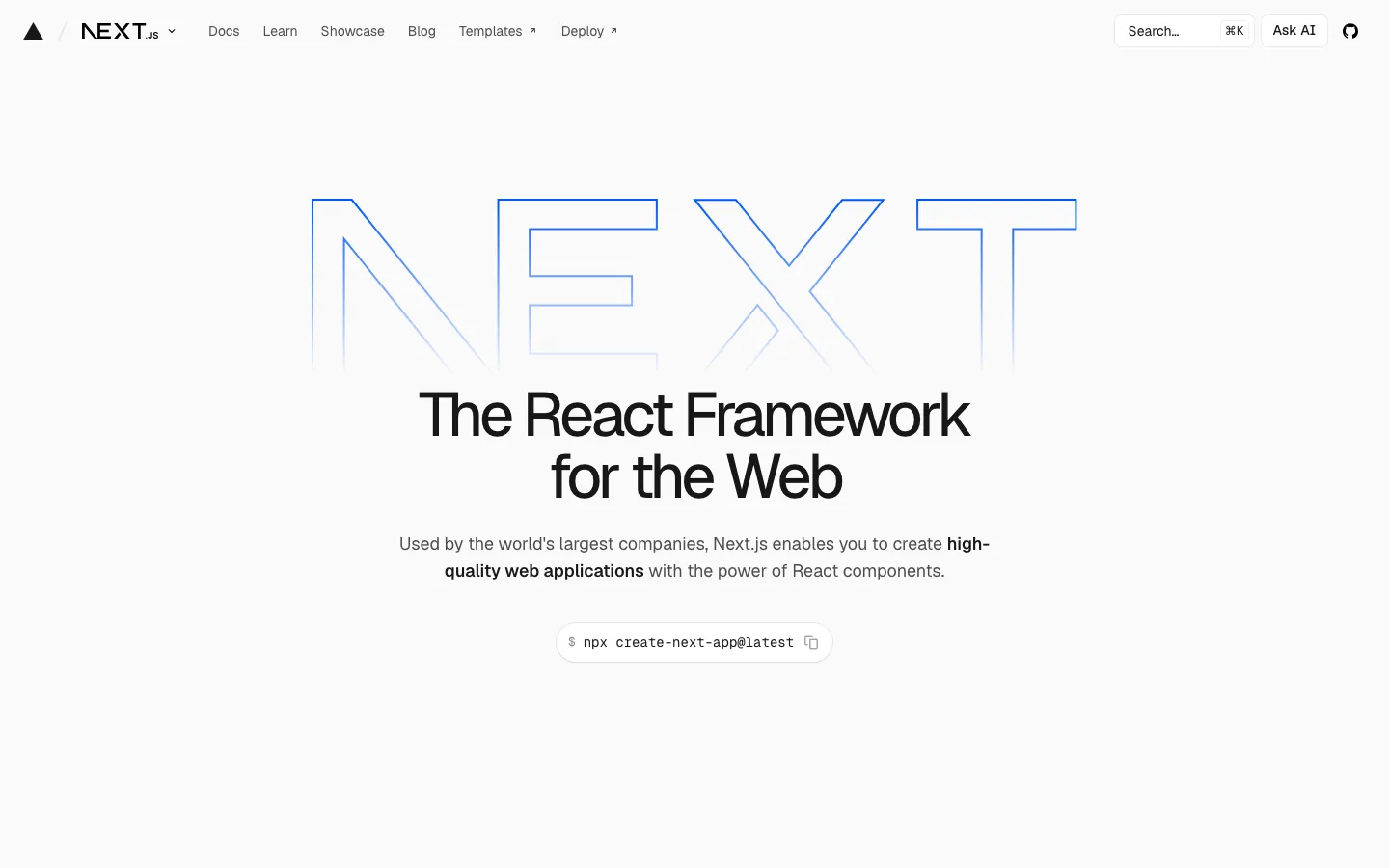
nextjs.org homepage, captured on 23 October 2026
What is Next.js?
Next.js is a free, open-source framework built on top of React and Node.js and maintained by Vercel. React provides the interface components. Next.js organises the application around them: pages, routes, rendering, caching and deployment.
Server and static rendering: each page can be generated on request, at build time or regenerated periodically.
React Server Components: components rendered on the server, with no extra JavaScript in the browser.
Built-in optimisations: images, fonts and scripts optimised for Core Web Vitals.
API routes: server logic lives in the same project as the interface.
Version 16.4, released on 6 October 2026, brings lazy compilation, a lighter Turbopack output and the new features of React 19.3 (official Next.js blog).
Next.js and SEO
A classic React site builds its pages in the browser. Some bots, including most AI bots, then only read an empty page. Next.js server rendering delivers complete HTML, readable by Google and AI. Our guide to SEO for LLMs covers this point, and a Screaming Frog crawl with JavaScript disabled checks it page by page.
Real-world performance depends on implementation. HTTP Archive data cited by Astro shows 35% of Next.js sites passing Core Web Vitals, against 71% for Astro (astro.build). A fast Next.js site therefore requires real technical discipline.
Next.js, Astro or Webflow?
Criterion
Next.js
Astro
Webflow
Best use
Web app or site mixing content and features
Fast content site
B2B site run by marketing
Skills
React developers
Web developers
Visual editor, no code
Content
Headless CMS to add
Headless CMS to add
Built-in CMS
Hosting
Vercel or Node.js server
Static or server
Included
Marketing autonomy
Low without a CMS
Low without a CMS
High
Webflow is moving closer to these stacks with Source, which plugs into a Next.js or Astro project. Our article on Source by Webflow and our dedicated video (in French) explain the changes for marketing teams.
Our review of Next.js
Next.js is an excellent choice for a web app or a site with business features: client portal, configurator, dashboard. For a B2B site where content is the core, it adds complexity that Webflow or Astro avoid. Claude Code noticeably speeds up writing and reviewing code on a Next.js project.
Strengths
Server rendering that guarantees HTML readable by search engines and AI.
A huge, well-documented React ecosystem.
App features and the website in the same project.
Very simple deployment on Vercel.
Limits
Unnecessary complexity for a content site.
Performance that depends heavily on implementation.
Reliance on a development team for every change.
Next.js compared with Astro, Sanity and JavaScript
Astro focuses on content sites and ships less JavaScript.
Sanity provides the headless CMS for a Next.js project.
JavaScript is the language React and Next.js rely on.
Webflow remains better suited to a B2B site run by marketing.
FAQ: frequently asked questions about Next.js
What is Next.js?
An open-source framework built on React and developed by Vercel. It adds server-side rendering, routing and the optimisations React needs for production.
What is the difference between Next.js and React?
React is a library for building interfaces. Next.js is a framework that organises a complete React application: pages, server rendering, data and deployment.
Is Next.js good for SEO?
Yes, thanks to server rendering that delivers complete HTML. Performance, however, depends on the quality of the implementation.
Do you need Next.js for a company website?
Rarely. A B2B content site gains autonomy and simplicity on Webflow. Next.js makes sense when the site includes app features.