Oops! Something went wrong while submitting the form.
🍪 Cookie settings
By clicking “Accept all”, you agree to the storing of cookies on your device to enhance site navigation, analyze site usage, and assist in our marketing efforts. See ourPrivacy Policy for more information.
Astro is an open-source web framework built for content websites: marketing sites, blogs, documentation. It renders HTML on the server and only ships JavaScript to the components that need it. It is often paired with a headless CMS such as Sanity.
71% of Astro sites pass Core Web Vitals, according to HTTP Archive data cited by Astro.
Astro 7.4 available in October 2026.
Free and open-source framework, under the MIT licence.
Compatible with React, Vue, Svelte, Preact and Solid.
Deploys to Netlify, Vercel, Cloudflare or AWS.
AI-generated summary
Astro is a JavaScript framework designed for one specific use: websites where content matters more than interactivity. It renders pages as HTML on the server and only ships JavaScript to the elements that need it. The result shows in speed, and therefore in SEO and readability by AI. Our custom offer pairs Astro and Sanity for projects that go beyond Webflow.
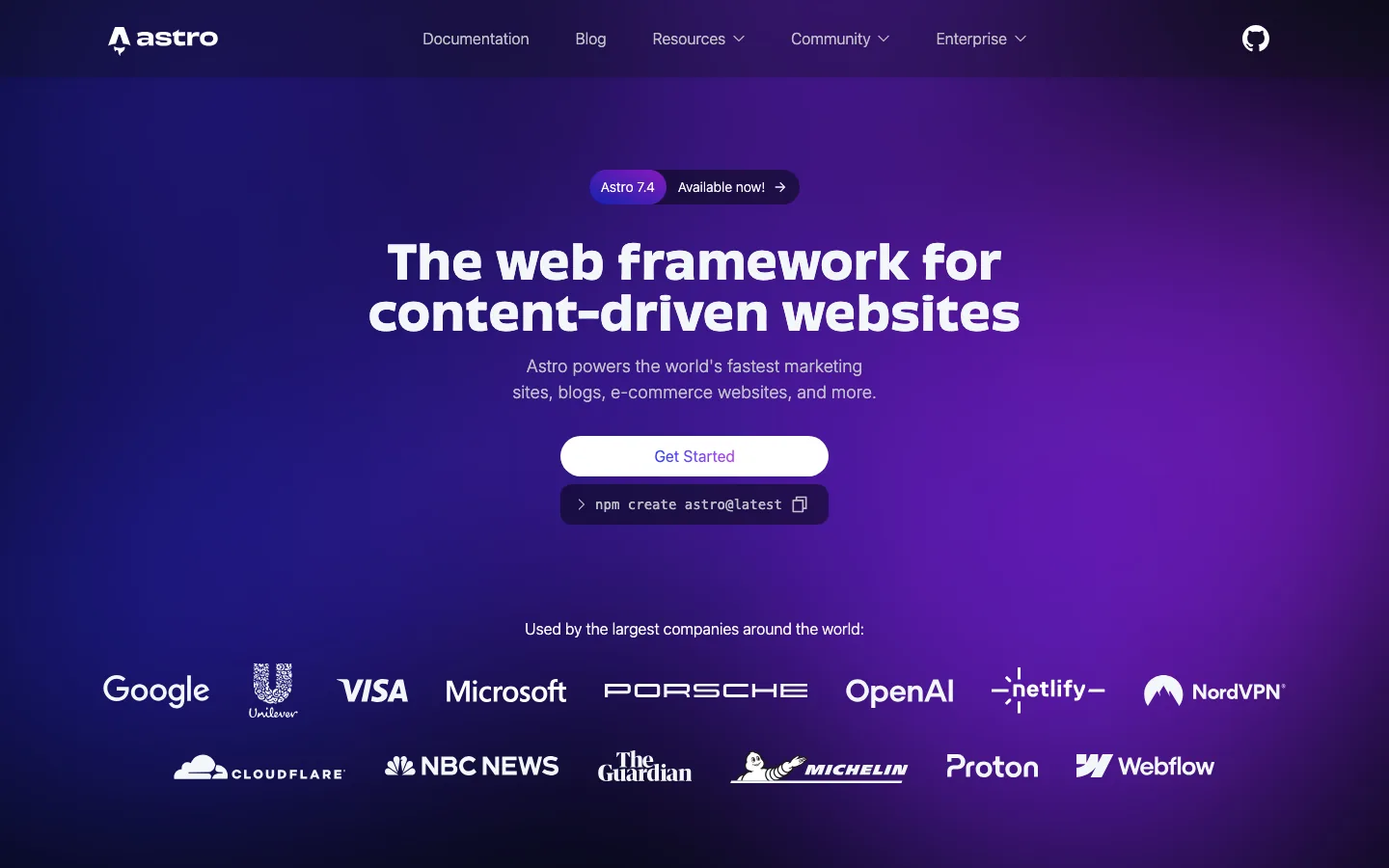
astro.build homepage, captured on 23 October 2026
What is Astro?
Astro is a free, open-source web framework under the MIT licence. It sits at the same level as Next.js or Nuxt, with a different philosophy: server first, JavaScript only where it helps. Version 7.4 is available in October 2026 (Astro official website).
Islands architecture: each interactive component loads on its own, the rest of the page stays static HTML.
Content first: data comes from Markdown files, an API or a headless CMS.
Framework freedom: React, Vue, Svelte, Preact or Solid live side by side in one project.
Deploy anywhere: adapters for Netlify, Vercel, Cloudflare, AWS or Node.js.
Astro's performance in figures
Astro publishes the share of sites passing Core Web Vitals by framework, based on real-world data from HTTP Archive and the Chrome UX Report. Astro highlights these figures to support its message, yet the underlying data is public.
Framework or CMS
Sites passing Core Web Vitals
Astro
71%
WordPress
48%
Gatsby
45%
Next.js
35%
Nuxt
28%
Source: astro.build homepage, taken on 23 October 2026. A fast site delivered as HTML is easy to read for Google and AI bots, as our guide to SEO for LLMs explains.
Astro or Webflow?
Webflow combines design, CMS and hosting in a visual tool. It also produces clean, fast HTML and keeps the marketing team autonomous. Astro requires developers, a headless CMS such as Sanity and separate hosting.
Webflow for most B2B websites, run day to day by marketing.
Astro for a content-heavy site with specific needs: a large number of pages, business integrations, custom logic.
Webflow is following this shift with Source, which plugs into Next.js or Astro stacks. We analyse it in this video (in French) and in our article on Source by Webflow.
Our review of Astro
Astro is the framework we choose when a content project goes beyond Webflow. It delivers fast pages by default, with no optimisation effort. Paired with Sanity and code assisted by Claude Code, it enables custom websites without sacrificing performance.
Strengths
Excellent performance by default.
Server-rendered HTML, readable by search engines and AI.
Freedom to mix UI frameworks.
A free, very active open-source project.
Limits
Developers needed to build and evolve the site.
A headless CMS to add for the marketing team.
A weaker fit for highly interactive applications.
Astro compared with Next.js, Sanity and Webflow
Next.js is better suited to interaction-heavy web apps.
Sanity provides the headless CMS that feeds an Astro site.
Webflow remains the simplest option for a B2B site run by marketing.
JavaScript remains the base language of these frameworks.
FAQ: frequently asked questions about Astro
What is Astro JS used for?
To build fast content websites: marketing sites, blogs, documentation or simple e-commerce. It renders HTML on the server and limits the JavaScript sent to the browser.
Is Astro better than Next.js?
For a content site, Astro is usually faster and simpler. For a highly interactive web app, Next.js remains the better fit.
Is Astro good for SEO?
Yes. Pages are delivered as complete HTML, load fast and are readable by Google and AI bots.
Is Astro free?
Yes. Astro is an open-source project under the MIT licence. Only hosting and related services are paid.