Webflow Conf 2026: key takeaways and what they mean for your site

17 minutes
.
September 7, 2026
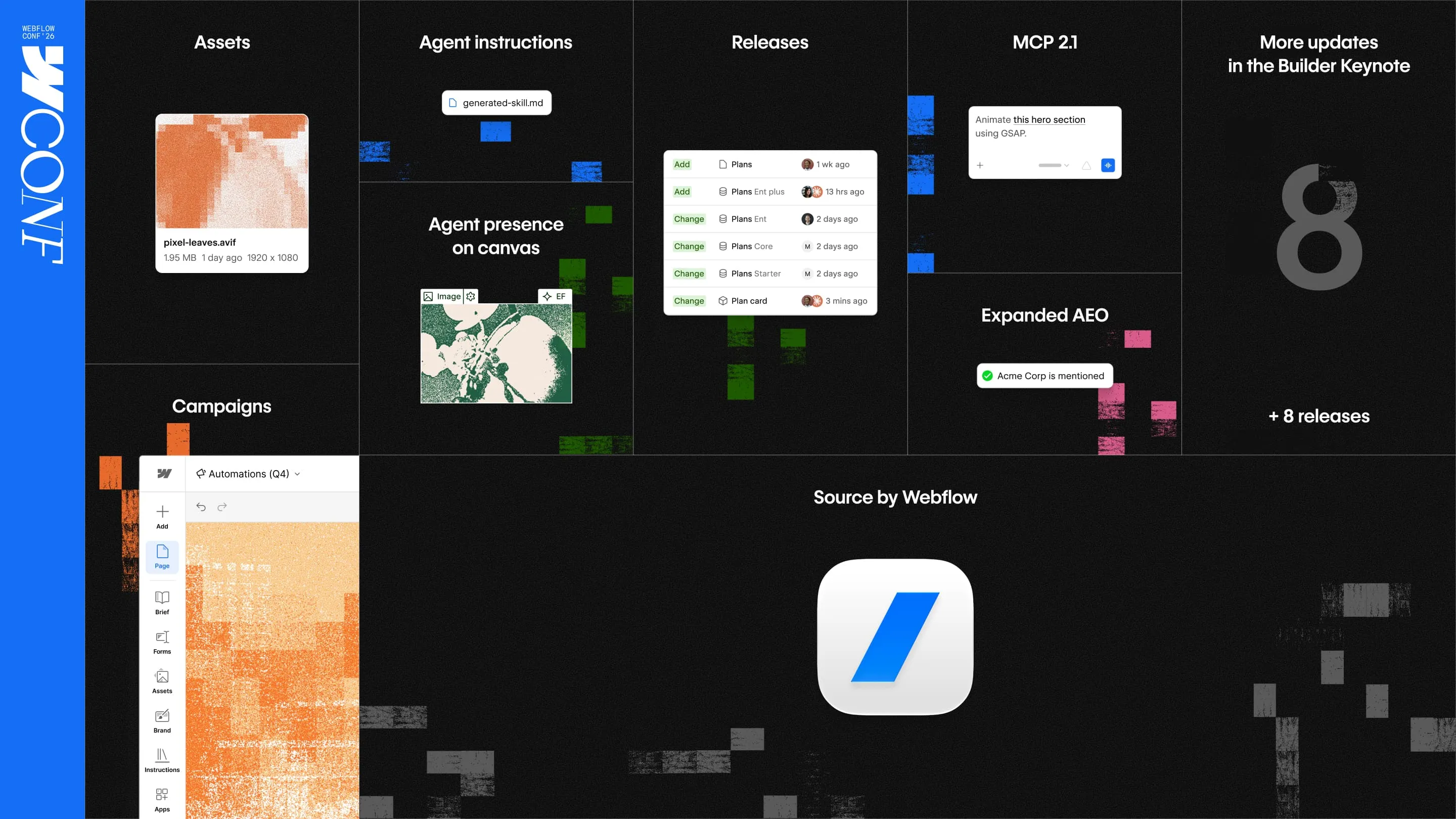
Webflow held its Webflow Conf 2026 in Boston from September 1st to 3rd, with an opening keynote on September 2nd. Linda Tong (Webflow CEO) introduced the core concept behind all the announcements: writing code has become accessible to everyone, so the term "builder" no longer refers only to designers, developers, and agencies. It now includes marketers and AI agents. Source, MCP 2.1, AEO content agents, Campaigns, Releases... every new feature stems from this perspective. This article explains what each announcement enables and how it changes things for a business, a marketing team, or a Webflow agency.
Webflow Conf 2026 took place in Boston and online from September 1st to 3rd, 2026. Webflow announced Source, a new agentic platform in research preview, as well as MCP 2.1, Releases, Agent Instructions generation, Agent Presence, content agents in Webflow AEO, and two products for marketers: Campaigns and Assets. A Builder keynote rounded out the day with improvements to the Designer and CMS.
| Announcement | Description | Who it is for | Announced availability |
|---|---|---|---|
| Source by Webflow | A platform where marketing teams and AI agents work on the site's code, with role-based workspaces | Marketing teams, agencies, developers | Limited research preview, by application |
| Campaigns | From brief to landing page, variants and ad creative, with agents | Performance marketers | In beta, available for purchase in October 2026 |
| Assets | On-brand creative production and adaptation, built on Vidoso technology | Brand and content teams | Beta in October 2026 |
| Webflow AEO content agents | Find topics where competitors get cited, write the brief and draft directly in the CMS | Marketing, SEO and AEO | Enterprise customers |
| MCP 2.1 | GSAP interactions, advanced CMS querying, Webflow Cloud logs available to agents | Developers, agencies | All customers, September 2026 |
| Releases | A full branch of the site (pages, CMS, components, assets, locales) before going live | Large teams | Beta by the end of the year |
| Agent Instructions generation | Context files for agents generated from the existing site | All teams | Rolling out from September 2, 2026 |
| Agent Presence | Agents' position shown live on the canvas, like a teammate | All teams | All customers, September 2026 |
| Builder keynote | Components in the CMS, breakpoint canvas, visual editing for code components, popovers, performance | Designers, developers | Immediate or within the following weeks depending on the feature |
The dates come from the official Webflow article and the Builder keynote recap. When Webflow wrote "later this month" on September 2nd, we translated it as "during September 2026." No pricing was announced for the new products.
Linda Tong’s opening thesis has two parts. Code is becoming a commodity, so the differentiator for brands will be their expertise and the teams capable of scaling it. And since anyone can produce code, the team building a site has expanded to include marketers and agents. Webflow has drawn a clear conclusion from this: the platform needed to be redesigned to serve these two profiles just as it has always served designers, developers, and agencies.
This perspective aligns with what we see every month with our clients. Going live is no longer the defining moment of a web project. A B2B site is judged by what it produces six or twelve months after launch, by the leads it generates, by how ChatGPT or Perplexity cite it, and by how quickly the team evolves it. Webflow has just organized its entire roadmap around this "after" phase.
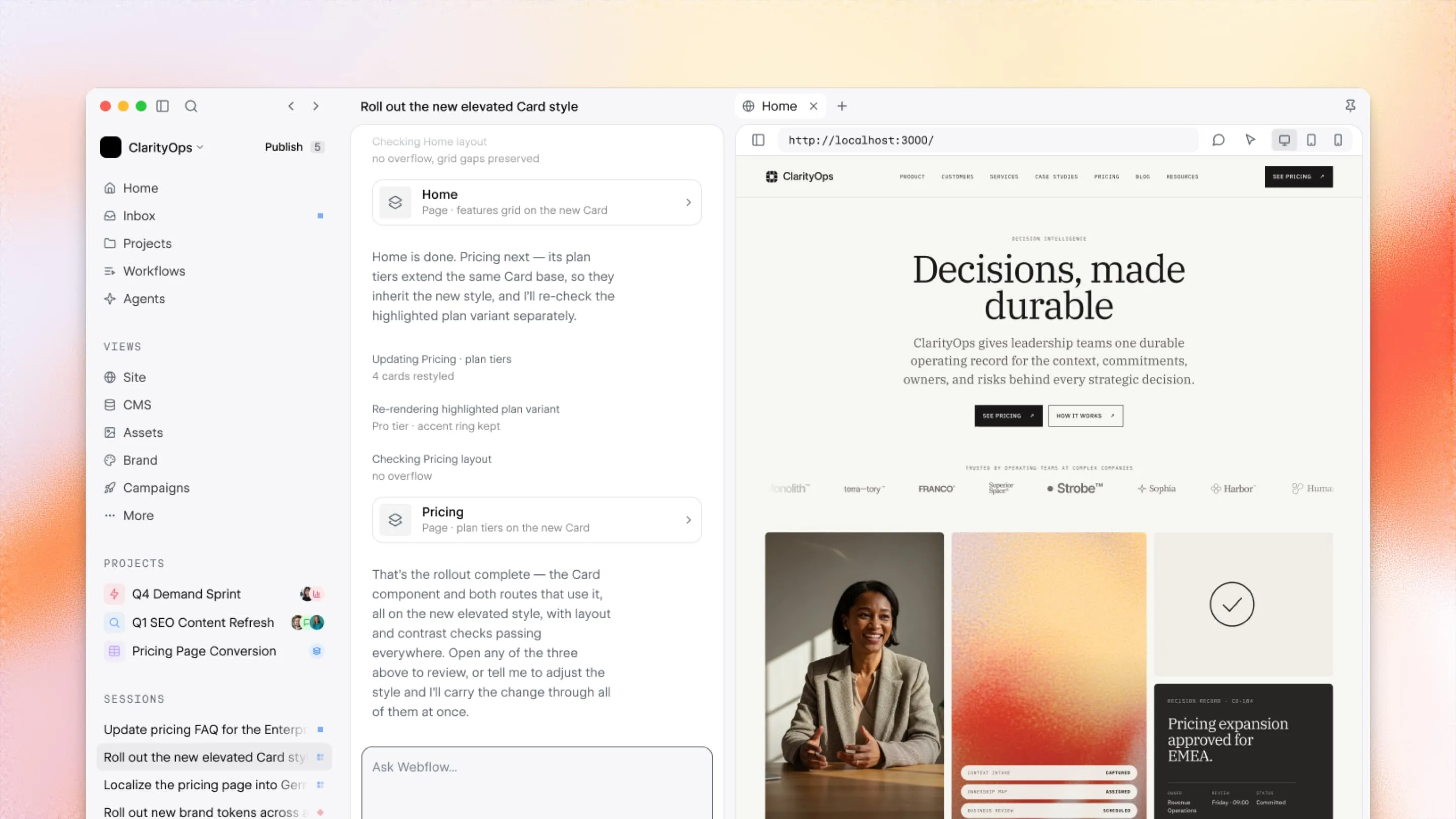
Source by Webflow is a new environment (separate from the Designer) where marketing teams and their AI agents launch, optimize, and evolve a site using code as a common foundation. It connects to an existing codebase, CMS, hosting, and the marketing tools already in place (including Webflow sites). The product is currently in a limited research preview by application, with no pricing or release date announced.
Webflow highlights three principles. Code becomes the source of truth, allowing agents to handle major changes without an abstraction layer, while the visual canvas writes in that same code. Views provide each team member with a workspace tailored to their role, featuring a brand system, role-based access, approval workflows, and action history. Finally, agents run in the background, measuring performance, identifying opportunities, and dropping pre-written, ready-to-approve recommendations into an Inbox.
In the FAQ published by Ben Haefele, Webflow clarifies that the current platform will continue to be developed and that a "supported" migration path will be offered, though no date has been set. We published an initial analysis of Source by Webflow on the day of the announcement, detailing the six Views delivered in the preview, our agency's perspective, and the questions left unanswered, such as pricing and the future of existing Webflow sites. We won't repeat that here. Let's keep one thing in mind for what follows: Source describes the direction, and each announcement below is a building block already available or currently being rolled out in the Webflow you use today.
Webflow frames the problem well in its announcement. An agent moving quickly in production raises the same questions as a new employee: What did they change, who asked them to do it, and did someone review it before it went live? Four announcements address these questions:
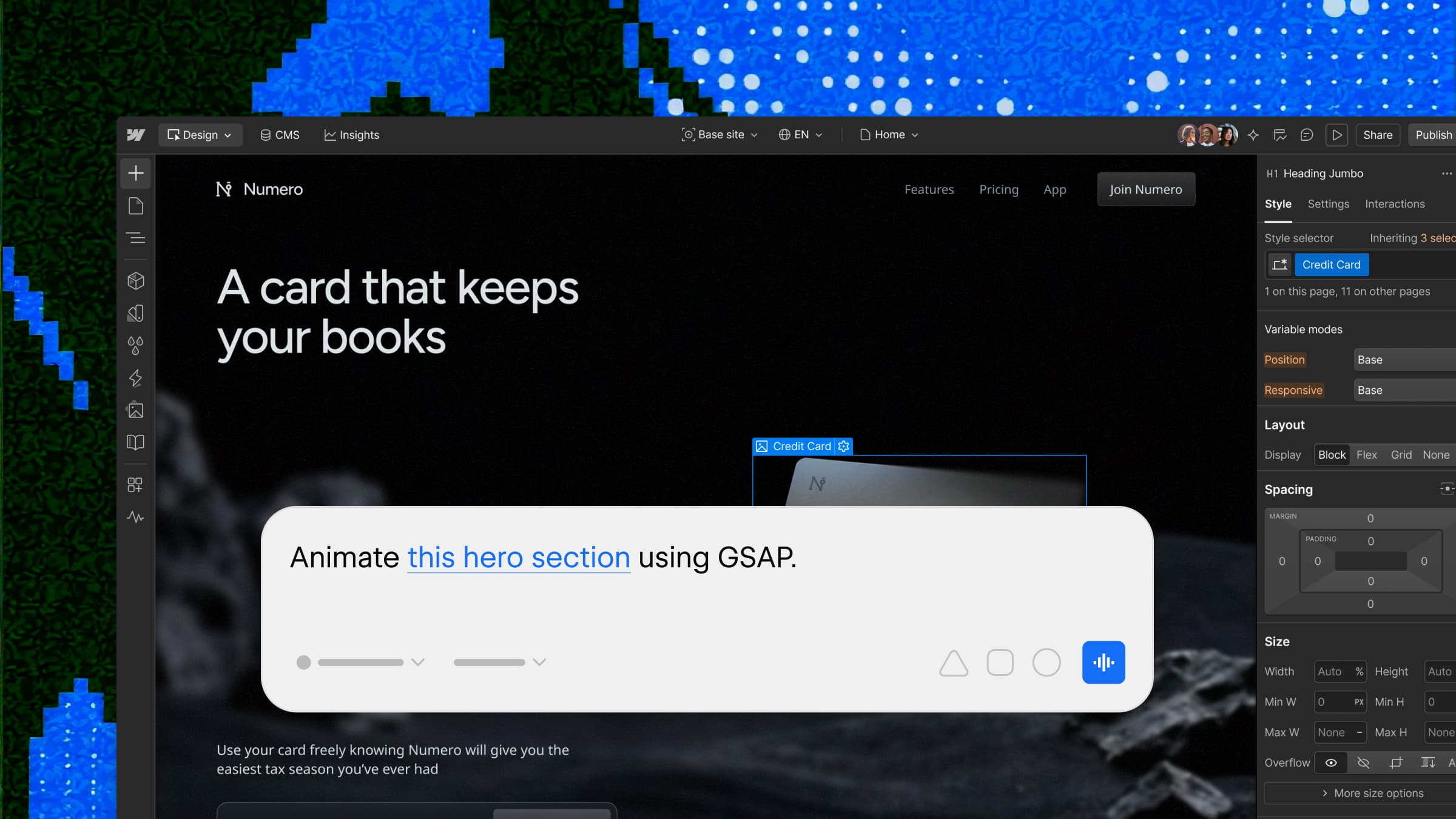
The Model Context Protocol (MCP) is the standard that allows an AI assistant like Claude, ChatGPT, or Cursor to read and modify a Webflow site through an official connection. Webflow MCP 2.0, released this summer, opened up the design system, component properties and variants, and Webflow Analyze data to agents. MCP 2.1, scheduled for all customers in September, expands this scope in three directions.
First, GSAP interactions. You describe the desired animation, including a timeline-based sequence, and the agent builds it as a native GSAP animation, with the usual visual controls to adjust timing. Second, CMS queries. Previously, an agent could only sort and filter on a few fields, provided it knew the exact name. It can now filter on custom fields, search through reference fields, and paginate results, allowing it to find the right content in a single query. Finally, Webflow Cloud. Deployment error logs are now sent back to the agent, allowing Claude Code, Codex, or Cursor to fix and redeploy without the developer having to toggle between the terminal and the dashboard.
We have been running Claude with the Webflow MCP on noqode.fr and several client sites for over a year, and the CMS query is the evolution we will feel first. A content audit on an 80-article blog used to require a chain of requests, consuming tokens for a result that a well-designed database returns in a single call. For a team that pays for AI by usage, this technical detail shows up on the invoice. Webflow has announced further versions by the end of the year, with expanded access to AEO data and Webflow Optimize, and its Updates page notes that Webflow is now available in Codex.
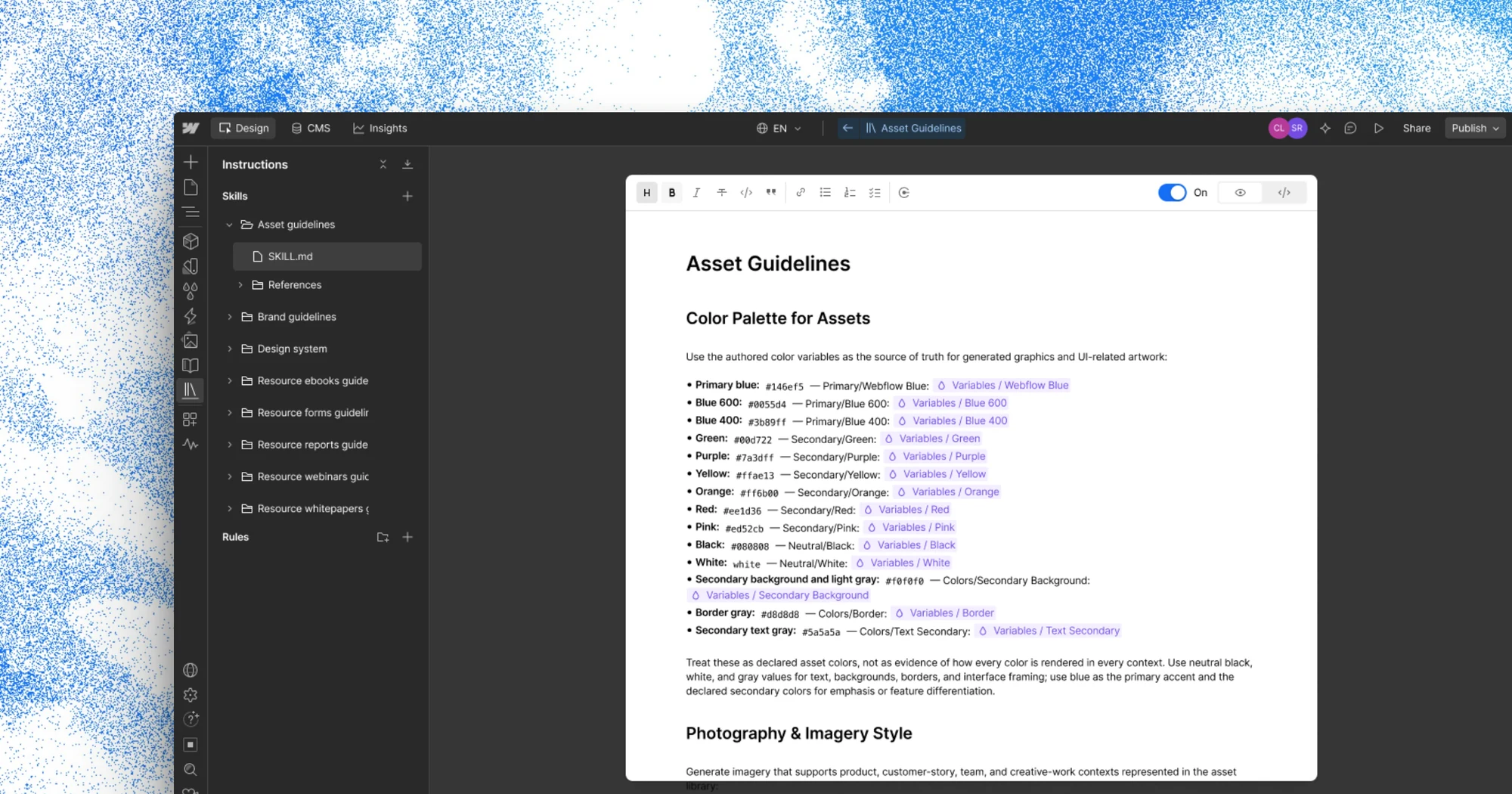
Agent Instructions, launched this summer, are markdown context files that explain to an agent how your site works. How the design system is applied, which legal disclaimers are non-negotiable, and what tone the brand adopts. The hurdle was the time required to write them. Webflow can now generate them based on what it already knows about the site, with four templates at launch: brand guidelines, design system, asset guidelines, and CMS content. The files can be edited and regenerated as the site evolves. Deployment began on September 2nd.
This announcement seems modest compared to Source. Yet, it will have the most impact in the short term. An agent without context produces generic work that requires revision. An agent with the right instructions produces compliant work on the first try.

Agent Presence displays in real time where an agent is working on the canvas just as Webflow displays a colleague's position. The site's activity log has been tracking every change made by an AI since this summer. Agent Presence solves a more immediate problem: "collisions." Two people editing the same element or a publication launched before the agent has finished. The feature is coming to all customers later in September.
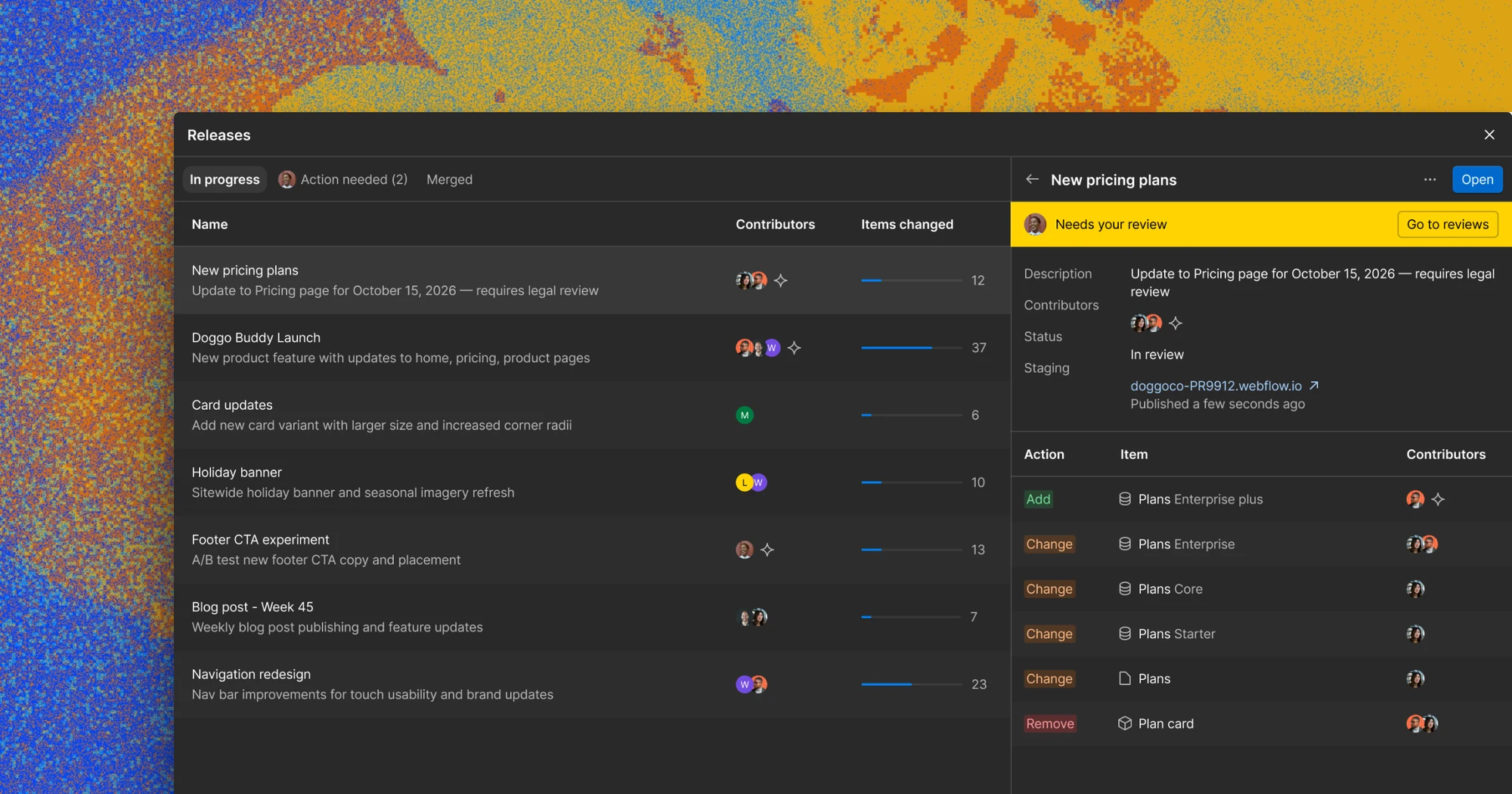
Releases allows you to create a complete branch of a site (including pages, CMS content, components, assets, and locales) to prepare for a launch without touching production. A Release Manager tracks ongoing work, what has been modified, by whom, and the status of each release. When a release is published, its updates are merged back into any still-open branches. Agents contribute to this with the same roles and permissions as humans when merging and publishing.
Webflow already offered page-level branching on Enterprise plans. Releases extends this logic to the entire site, content included, which addresses the needs of teams preparing for a rebranding or product launch. Pages and the CMS evolve together, and nothing goes live halfway. The beta is announced for the end of the year, with no details yet on which plans will be included.
AEO (Answer Engine Optimization) refers to the practices that allow a site to be mentioned and cited in responses from ChatGPT, Claude, Gemini, Perplexity, or Google’s AI Overviews. Webflow AEO, launched earlier this year, measures this visibility and suggests corrections. The conference adds a new step: content production by agents.
The figure that justifies the rest comes from a Webflow analysis of 2,000 companies. The median company appears in 16% of the AI responses where it would like to be featured, and is cited as a source only 6% of the time. Webflow also claims that its AEO clients achieve 70% more mentions and 120% more citations than non-Webflow brands. This second figure requires the caution that Webflow itself notes. It is "directional" internal data comparing 158 clients who applied AEO recommendations to 187 clients who received the same recommendations but did not apply them, from May 19 to July 13, 2026, without isolating the effect of the recommendations from other factors like seasonality.
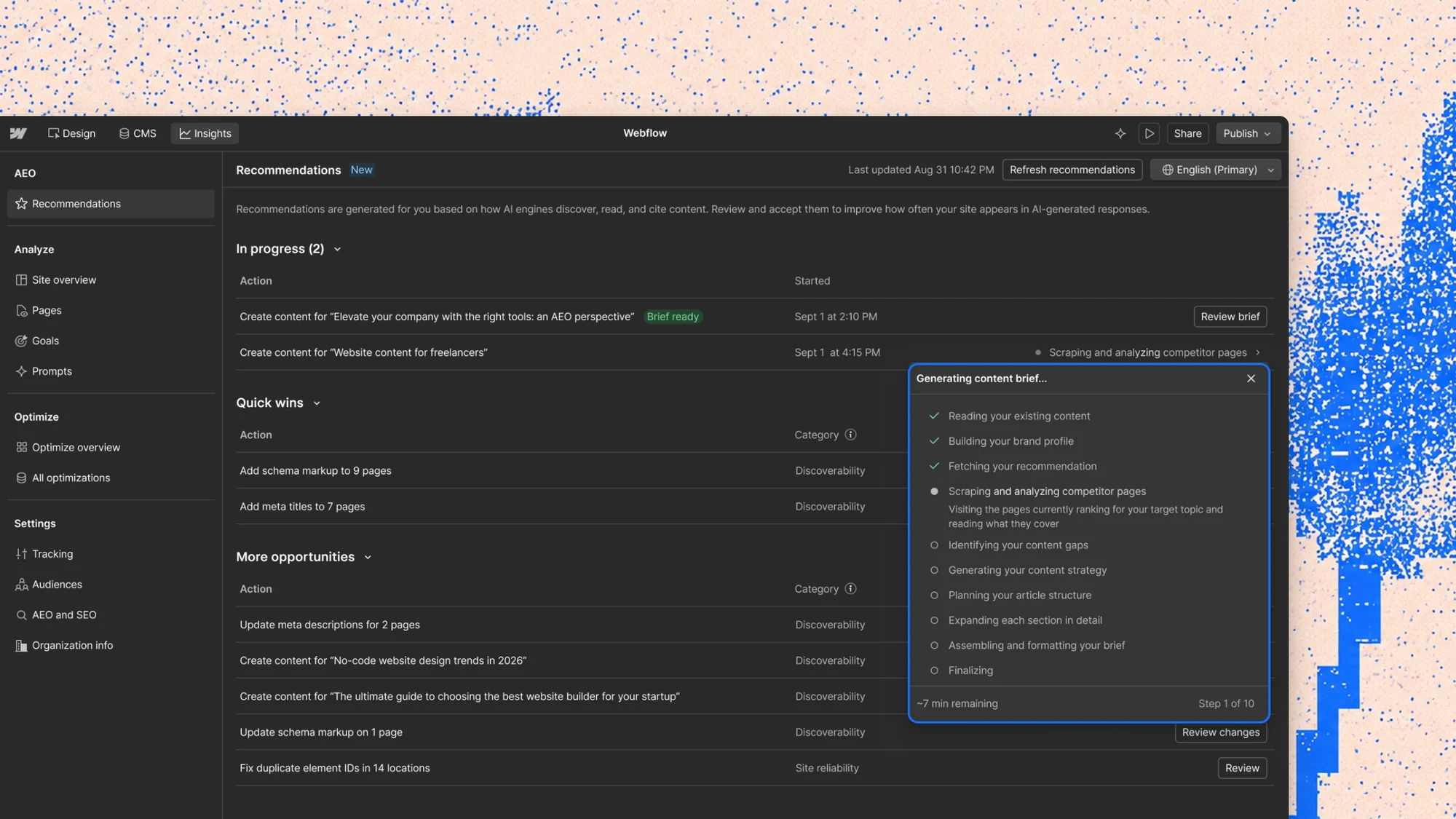
Webflow AEO aggregates data from ChatGPT, Claude, Gemini, and Perplexity to show where a brand is mentioned, where it is cited, and who is being cited in its place. Since hosting and analytics live within Webflow, the module links this data to AI bot visits to the site, traffic referred by LLMs, and conversion, after which agents generate prioritized recommendations that the team can approve, modify, or reject. The new content agents go further. They identify topics where your competitors are cited and you are not, write the brief, and then create a first draft directly in the CMS. Agents for refreshing existing content will follow, then access for external agents to AEO data via MCP by the end of the year. AEO agents are enabled by default for Enterprise clients, and analytics are handled through Webflow Analyze for Enterprise.
These two products are the only ones from the keynote that do not directly concern building or optimizing a site. They are aimed at marketers who need to deliver a campaign on ground previously occupied by specialized tools.
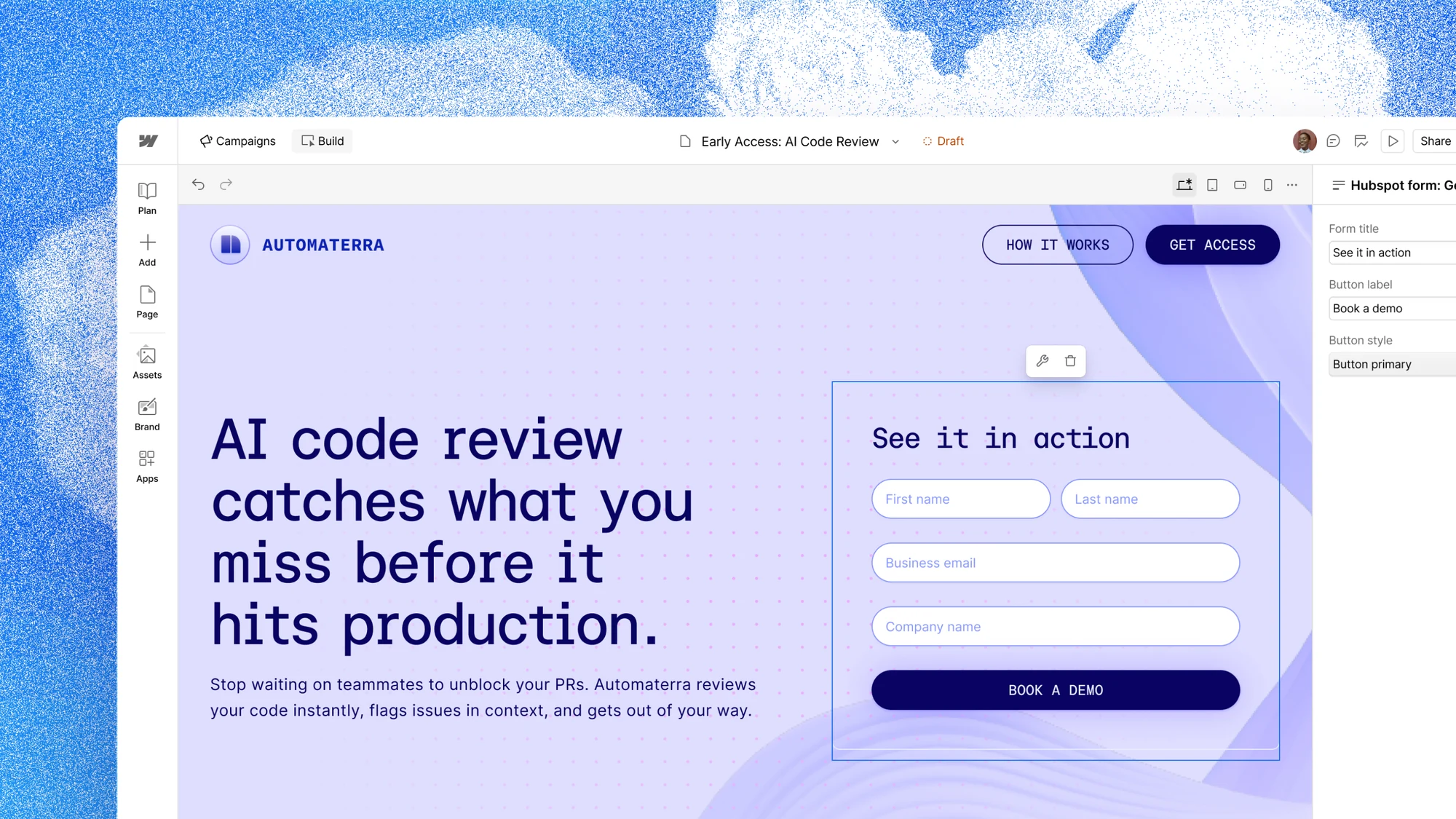
Campaigns targets performance marketers who want to go from an idea to an online campaign in a single day. The process begins with the URL of an existing site, from which an agent extracts colors, fonts, and interface elements to build a brand system, regardless of whether the site runs on Webflow or not. The marketer submits their brief, which an agent refines based on audience, messaging, and channels. Campaigns then generates the main landing page, variants by audience, target account, or keyword, and the associated ad creative, with the ability to deploy to Google Ads. Once the campaign is launched, the tool tracks conversions, connects to HubSpot or Salesforce to measure the pipeline, and its agents suggest iterations. Campaigns is in beta, with a commercial release announced for October 2026, with no pricing yet.
The detail that catches our attention is the starting point. Webflow does not require you to migrate to use Campaigns, which in our view makes it as much an acquisition product as a production tool. A team that adopts Campaigns for its landing pages places a portion of its marketing within Webflow before even moving its site there.
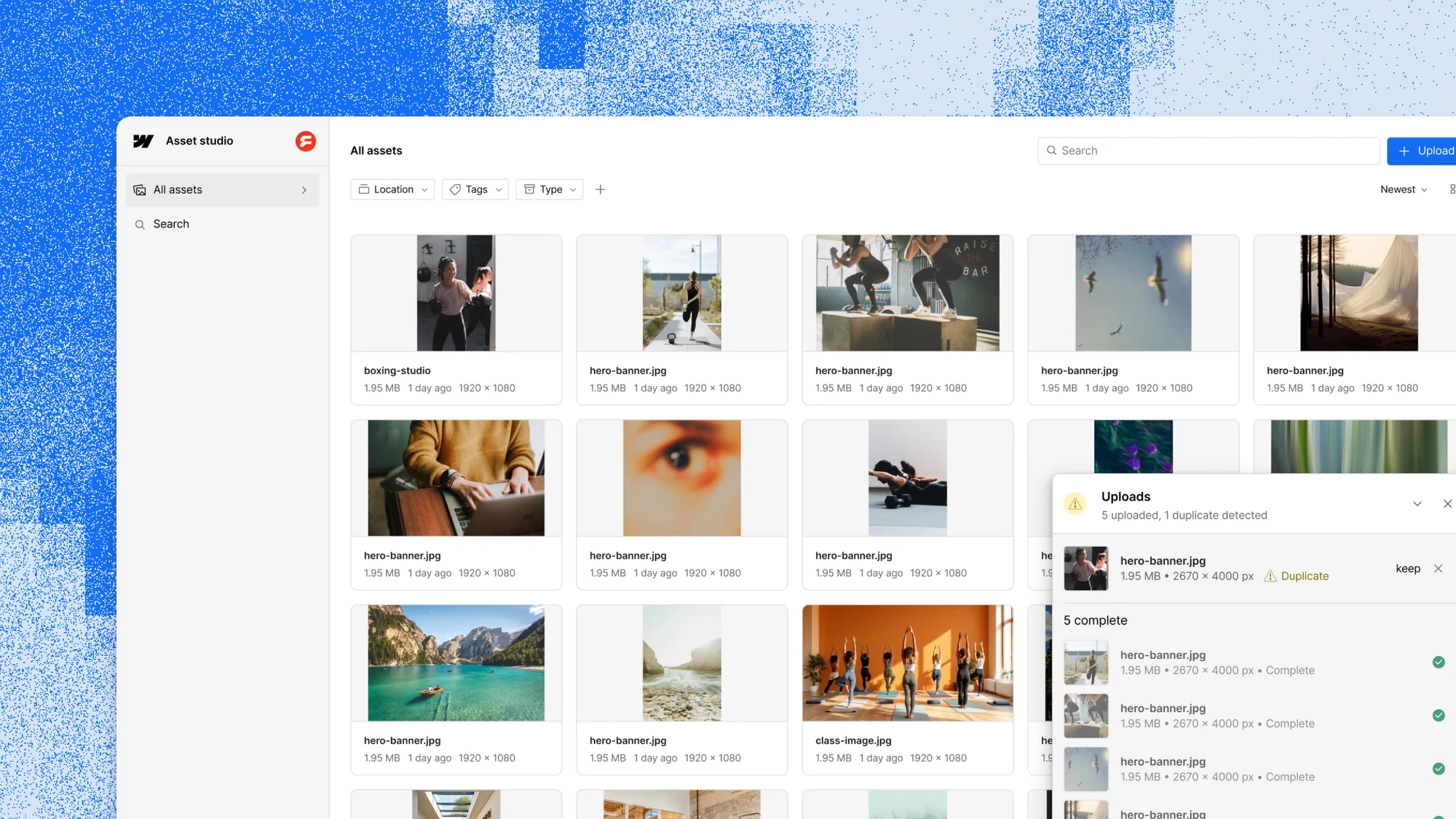
Assets addresses a problem that has emerged with AI-generated images and videos. Producing a visual takes two minutes, but the result never quite looks like the brand, and each adaptation drifts a little further from the original. Assets relies on Vidoso technology (acquired by Webflow in March) to find and adapt assets already approved within the context of the design system, brand variables, and the existing library. The cited use case ranges from static visuals adapted for the site to long-form video edited and subtitled for social media. The beta opens in October.
For a B2B SME launching three campaigns a year, the impact of these two products will remain limited in the short term. For a team managing a significant paid budget, or an agency producing landing pages in bulk, Campaigns could change how you work as early as this fall. We will test the beta before commenting on the quality of the generated pages.
For the first time, Webflow held a second keynote dedicated to those who build in the Designer every day. Webflow states it has delivered 151 improvements since Conf 2025, almost all of which came from community feedback. Here are those announced on September 2nd, along with their timelines.
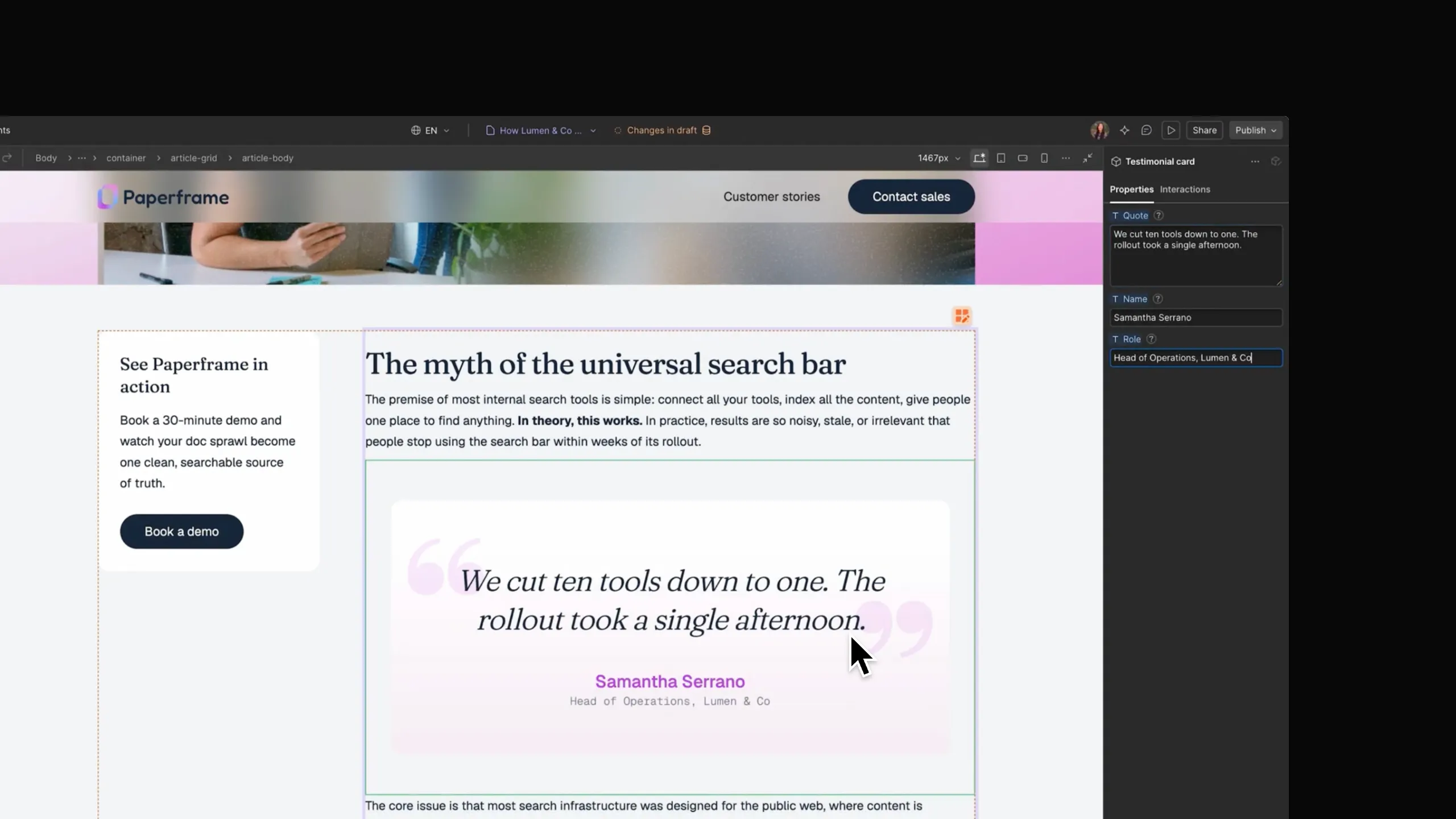
A call-to-action button, a testimonial card, or a pricing table can now be dropped directly into a rich text field, onto the canvas, or into a CMS item. Each instance is configured via props for that specific content. Previously, this required custom code or a workaround. An AI-generated component, such as an ROI calculator, works the same way, with each instance belonging to its own item. For an agency, the handoff becomes much simpler. The client quote component is built once, and the client's team adds it to their articles by changing the quote, photo, and name. The rollout began on September 2nd and reaches all customers the following week.
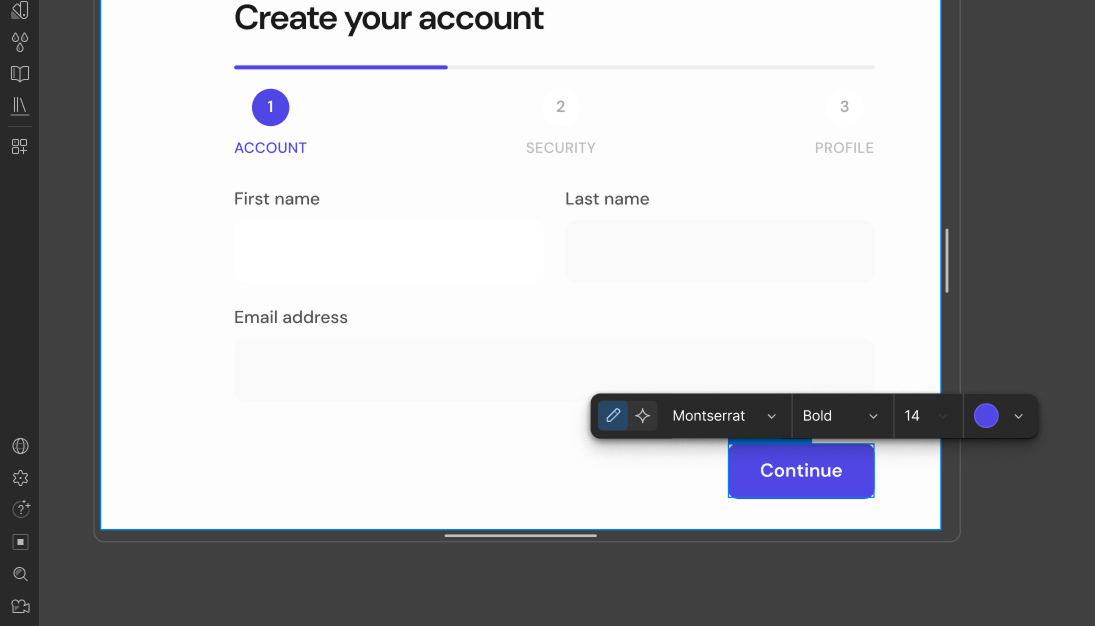
AI code components allow you to add custom functionality to your site by describing it to the Webflow assistant. Previously, the only way to modify the result was through new prompts. Now, the component can be selected on the canvas, styled in the Style panel, and edited directly in the text. You can also provide the element to be corrected as context to the assistant so that its next pass is limited to that specific point. The feature is available to all customers.
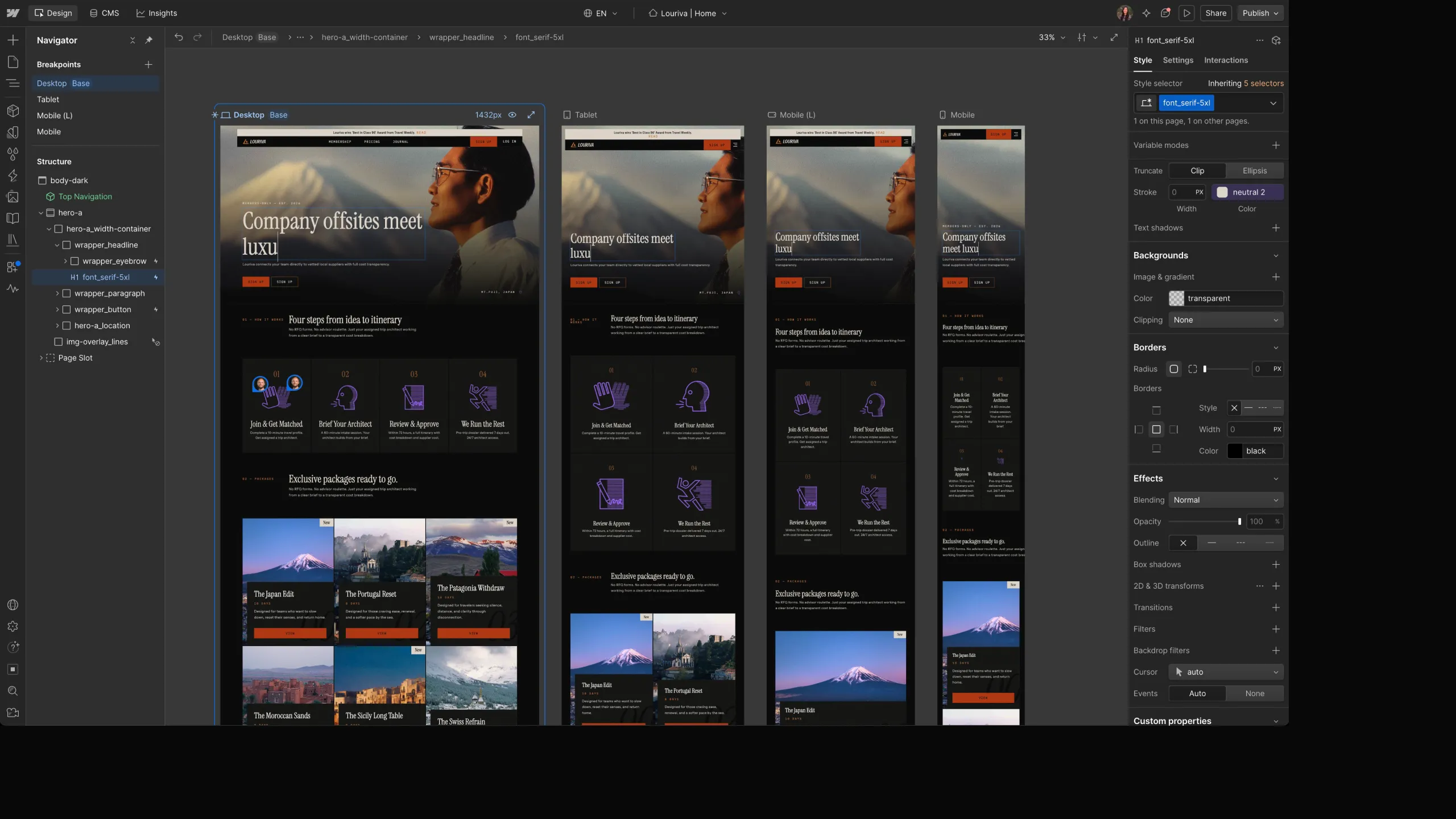
The breakpoint canvas displays all of a page's breakpoints side-by-side, including desktop, tablet, and mobile formats. Changes made on desktop are instantly reflected everywhere else without needing to click between breakpoints. It builds on three features released in recent months: margin and padding visualization on the canvas, the dedicated component canvas, and page pan and zoom. This is a real time-saver when reviewing the work of a colleague or an agent. Deployment began on September 2nd, reaching all customers the following week.
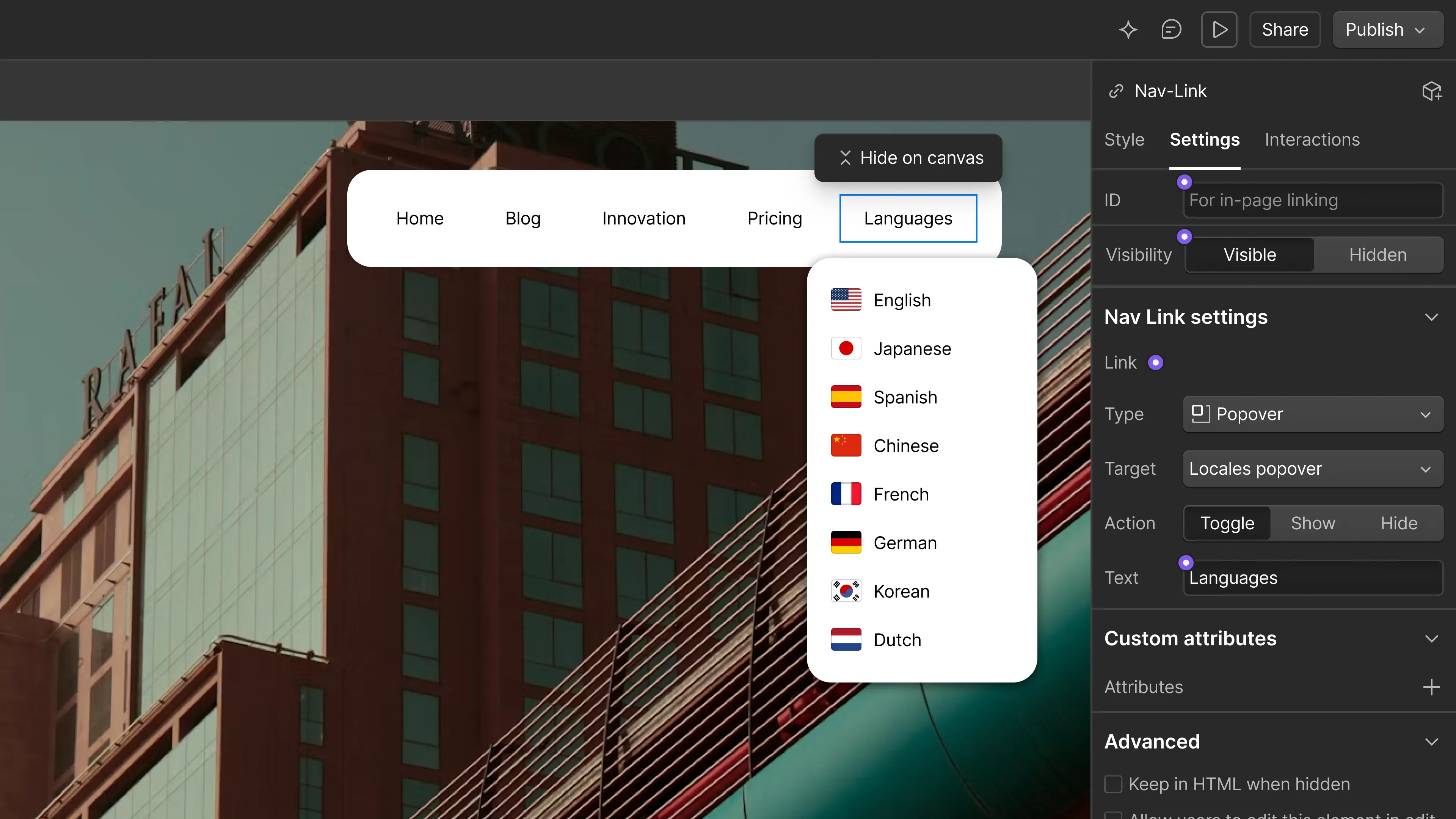
Popovers are native blocks for building modals, tooltips, banners, and menus without custom code. They rely on modern browser features like anchor positioning and the top layer rather than JavaScript, keeping pages lighter and more accessible. Webflow notes that these properly encapsulated components are easier for marketers to use and faster for agents to build. Native equivalents for sliders, tabs, and accordions are expected by the end of the year. Popovers will arrive in the coming weeks.
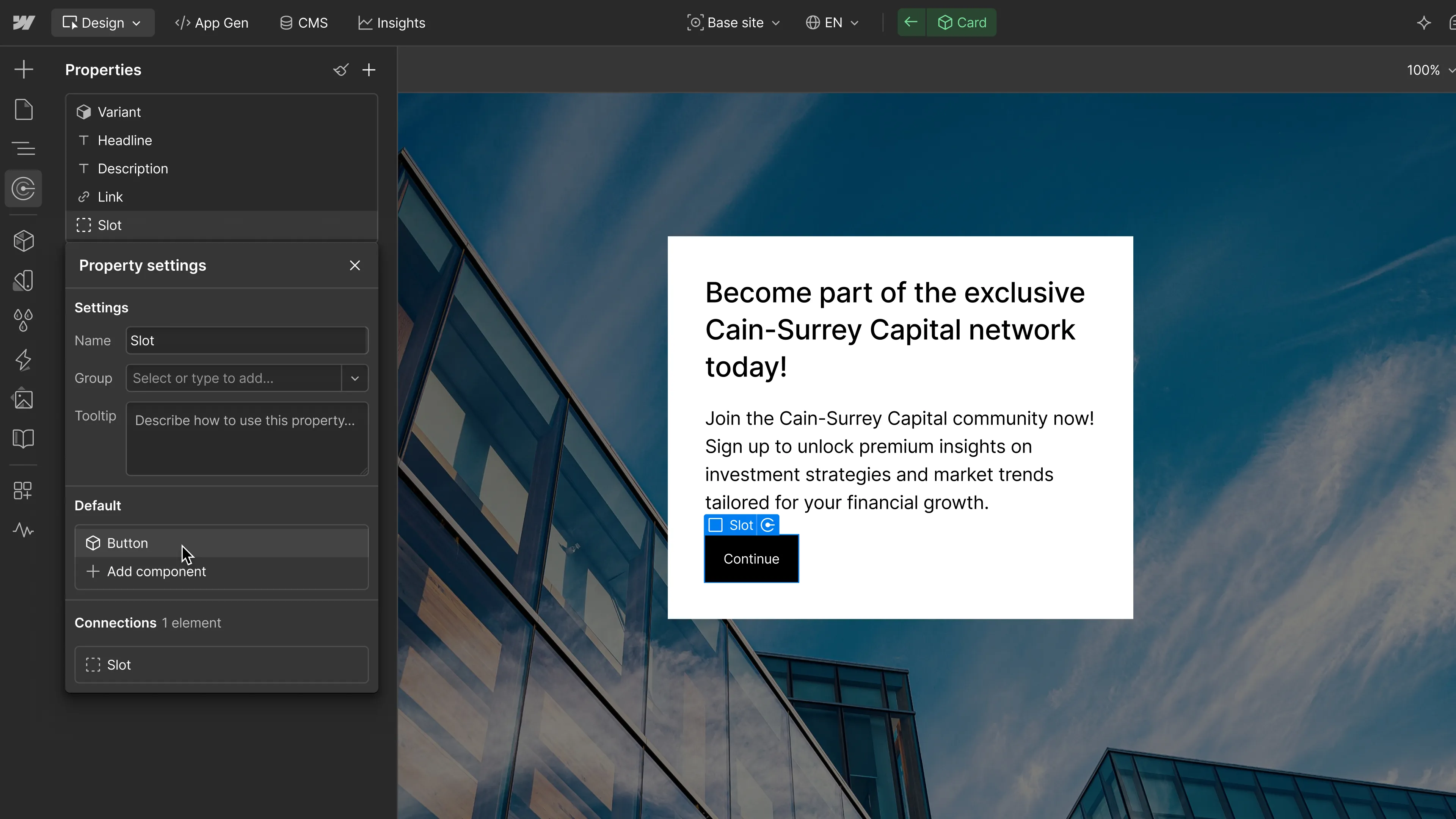
A component designed for one layout always ends up being used in another. Webflow introduced two safeguards in late August: visibility controls, which define which components a user with a Marketer role can see and use in build mode, and slot restrictions, which specify which components are allowed in a given slot. Default components go further by defining what a slot contains from the start. A new article will now arrive with the correct component already in place, rather than an empty slot that needs to be rebuilt. These rules also apply to agents using the MCP. Available later in September.
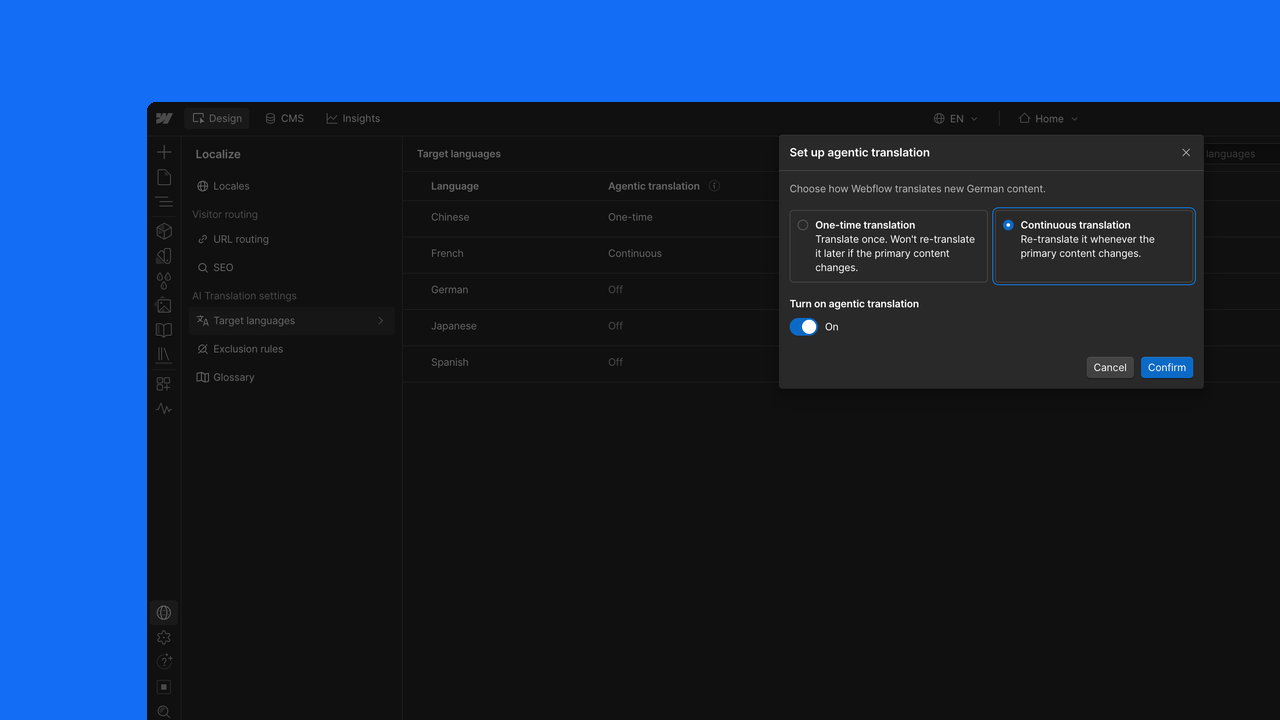
Webflow Localize previously enabled JSON file translation within a visual interface. Several features have been added in recent months: structure synchronization between primary and secondary locales, control over component property and custom code translation, and tone and formality settings per language. Translation itself remained manual. With Agentic Translation, every text update is automatically reflected in the correct language across all locales. Teams that want to maintain control can use these translations as a first draft. Webflow estimates this can save months when entering a new market. Rollout begins in the coming weeks.
Style props are coming to components. Designers will be able to expose specific colors or sizes while limiting the available options. This allows the team to maintain a degree of customization without granting access to the entire style system. Announced for the end of the year.
Webflow is sharing specific figures that are already in production for all customers.
| Operation | Gain announced by Webflow |
|---|---|
| Copying large elements in the Designer | up to 98% faster |
| Pasting in the Designer | 7.7 times faster |
| Rendering of published sites | up to 43% faster |
| Publishing | up to 80% faster |
These figures are maximums announced by Webflow and do not represent averages measured on your specific site. Designer loading, page switching, locale or CMS item changes, and input responsiveness are also reported to be faster. We will be verifying these on our own projects in the coming weeks.
Webflow Conf 2026 confirms what we wrote in our analysis of Webflow Source: websites are no longer just a deliverable; they are an ongoing operation. Webflow built its entire keynote around what happens after you go live. This includes agents that build within guardrails (MCP 2.1, Agent Instructions, Agent Presence, Releases), AI visibility that is measured and corrected directly within the platform (Webflow AEO), campaigns produced without relying on a designer (Campaigns and Assets), and a Designer interface that governs exactly what each user can edit. Source is not an isolated announcement. It is the direction that everything else is building toward.
This perspective aligns with the market as we see it. Code is once again a standard way to build a site because AI has made its production accessible. Sites that matter are judged by the leads they generate and how ChatGPT or Perplexity cite them. The designer encodes a system instead of drawing pages. The marketer evaluates proposals instead of opening tickets. The developer writes guardrails rather than components. The human remains in the validation loop, and Webflow has just made that the heart of its product.
We will test each of these new features on Noqode before integrating them for our clients. MCP 2.1, Agent Instructions, and CMS components are being added to our deliverables starting this month. Campaigns will be beta-tested in October, and we have submitted our application for the Source research preview. Two caveats remain. The pricing for Source, Campaigns, and Assets has not been announced, and AEO agents like Releases are primarily aimed at Enterprise clients. For SMEs, access to this wave will come through the Designer improvements available to everyone and through their agency. We will publish our results as we test. To be continued...