Webflow: A profitable growth engine? Forrester study analysis

6 minutes
.
April 25, 2025

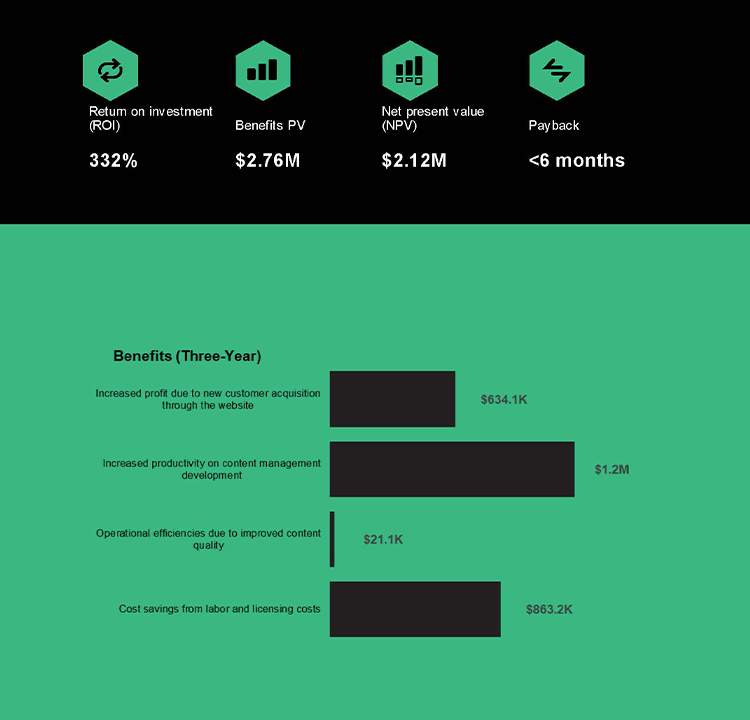
In a context where operational efficiency and profitability have become priorities, businesses are looking for solutions that can turn their websites into growth drivers. Webflow is often presented as a reference platform to increase the autonomy of marketing teams and reduce development costs. To substantiate these promises, the company commissioned Forrester Consulting, which published a Total Economic Impact™ study (source: Forrester TEI) highlighting a return on investment of 332% over three years and a 94% reduction in time-to-market.
This article offers an in-depth analysis of these figures and explains why Webflow is emerging as a strategic asset.

The study (full report) is based on the experience of several companies that have migrated to Webflow. It highlights two major gains: a drastic reduction in costs (hosting, maintenance, development) and greater autonomy for teams.
On the financial front, Forrester identifies average savings of $850,000 over three years. These savings come, on the one hand, from the removal of legacy infrastructure and, on the other, from the ability of marketing teams to manage a significant part of the site changes themselves. Developer intervention, which was previously required for each adjustment, is no longer systematic.
This operational autonomy has a direct impact on the speed of execution. While a traditional CMS can involve heavy and complex processes, Webflow streamlines iterations. Marketing can thus test page variations or highlight a new campaign without depending on a dedicated technical team.
Forrester also focuses on the speed of deployment of new features or new content. In a competitive environment, the ability to quickly launch a landing page or to adjust a user journey is a significant competitive advantage.
The report concludes that Webflow makes it possible to reduce by 94% the time required to make major changes to the site. This reduction comes from the combination of a complete visual editor and simplified management of the CMS, where the interface suits developers as well as marketing teams.
In practice, this means fewer validation cycles between departments and increased responsiveness when the market evolves. For a company, every day saved in the launch of a campaign can result in additional business opportunities.
Another strong point noted by Forrester is the rise in conversion rate, estimated between 15% and 30% after the adoption of Webflow. Several factors explain this:
Since organic search plays a major role in long-term lead acquisition, the contribution of a technically solid CMS is anything but anecdotal.
The Forrester report stresses Webflow's ability to adapt to varied needs, whether microsites, event pages, or more complex sites. As an organization grows, it can multiply digital projects without having to completely overhaul its web architecture.
This scalability is particularly sought after by large companies, for which it is an essential criterion. Included hosting, the possibility of creating subdomains and fine-grained management of user roles support this modular approach.
At Noqode, we see that the effectiveness of a platform like Webflow is multiplied when it is integrated into a global digital strategy. A site, even a very well designed one, does not spontaneously generate leads without:
Our expertise consists in combining the technical potential of Webflow with proven marketing approaches. In this way, we support our customers in multilingual localization, the management of high value-added content and the optimization of the user experience.
This combination favors a scalable, fast and business-oriented website, both for SMEs and for large companies wishing to conquer new markets.

The report published by Forrester highlights a reality: Webflow is not only a tool for creating sites but a strategic vector for organizations looking to optimize their costs and accelerate their time-to-market.
The promise of an ROI of 332% in three years and the 94% reduction in deployment time highlight the relevance of a platform combining technical performance and autonomy for marketing teams.
However, the challenge goes beyond the simple technological dimension. To fully exploit the potential of Webflow, it is crucial to develop a coherent digital ecosystem, combining SEO, quality content and acquisition strategy. It is in this spirit that Noqode supports its customers, by making Webflow a growth engine aligned with their business goals.