Webflow AEO Strategy: The Case Proving Branding Beats Market Share

9 minutes
.
May 28, 2026
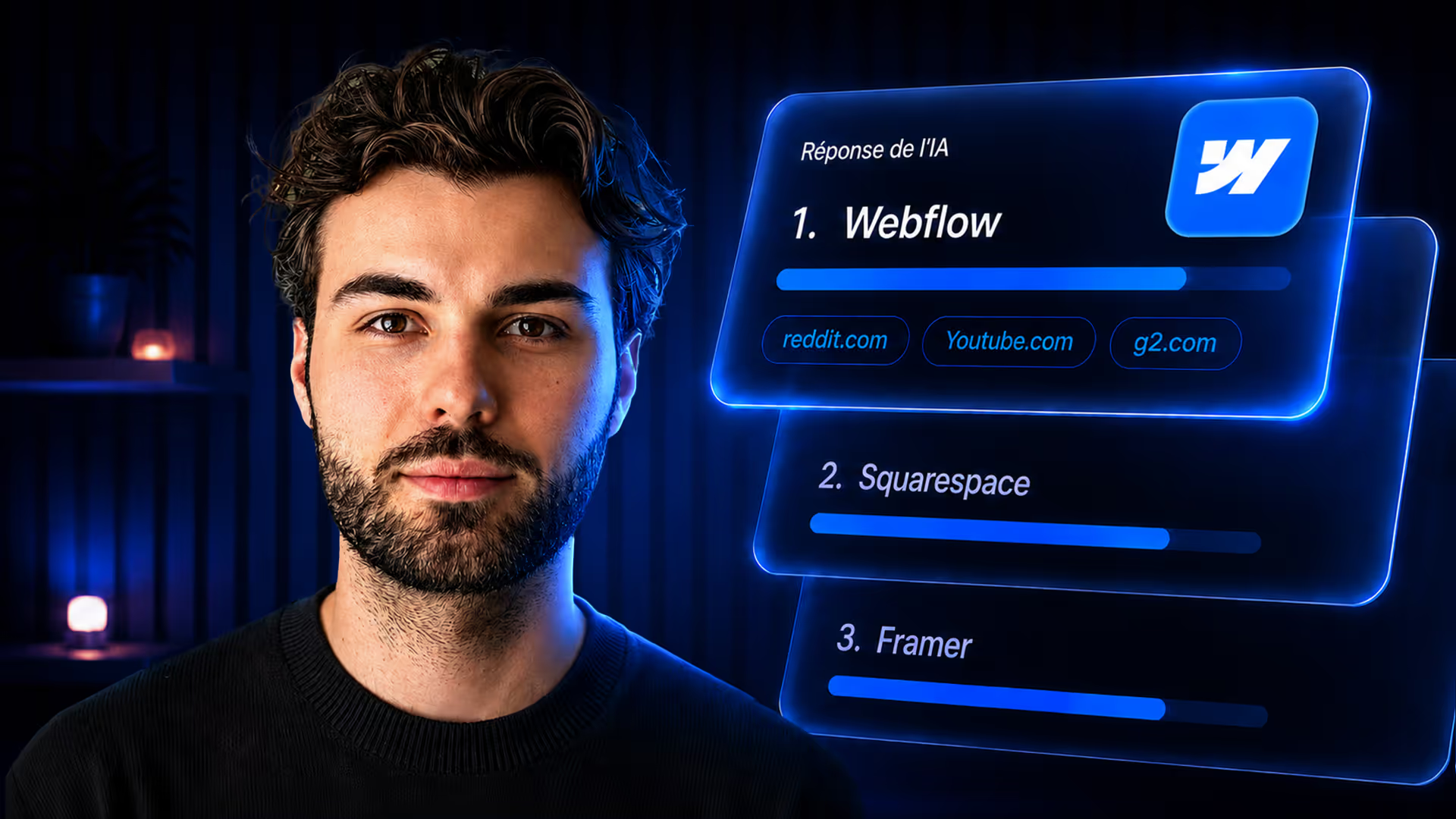
Webflow is 47 times smaller than WordPress. Yet, when ChatGPT is asked about the best website creation tools, Webflow comes out on top.
The real question isn't "how can such a small player dominate AI?" It's "what has Webflow understood about AEO that most brands still ignore?" Because this paradox is no accident: it's the result of a strategy methodically deployed over the past six months.
At Noqode, a Webflow agency pioneering AEO in France, we have thoroughly analyzed this entire strategy in the video above. This article provides a complete analysis, based on the official article published by Webflow and CMS market share data. The implications extend beyond Webflow: it concretely demonstrates how branding and site structure influence the way artificial intelligences cite you.
The starting point is a discrepancy that should be impossible. In the global CMS market, WordPress still dominates with approximately 60% of all websites, whereas Webflow represents only a fraction of a percent of the market according to W3Techs data. In raw volume, it's not even a contest.
And yet, visibility figures tell a different story. On Semrush, Webflow generates organic traffic of approximately 1.7 million visits per month, equivalent to over 210,000 euros in monthly Google Ads budget if these positions had to be purchased instead of being earned organically.
The most telling statistic directly concerns AI search. Webflow has nearly 30,000 mentions for approximately 17,000 ranked pages, with an authority of 48 globally and 76% in the United States. For a brand with such a small market share, this level of presence in AI models is completely disproportionate, in a good way.
This visibility largely comes from the sources that LLMs refer to the most. YouTube and Reddit play a crucial role, and Webflow wisely created a dedicated subreddit where the entire community discusses technical topics. In the United States, Reddit remains a go-to source for LLMs, and this community dynamic directly fuels the volume of citations Webflow benefits from. At Noqode, we ourselves sometimes ask technical questions there or interact with the Webflow teams during feature releases.
The entire approach is based on a three-pillar framework, detailed by Vivian Hoang, Webflow's AEO/SEO Lead, in the official article published on April 15, 2026, about their site redesign.
The impetus for the project stems from a team observation. The old homepage wasn't broken; it was even stunning, but a large part of what made it beautiful remained invisible to machines. Animations, scroll-triggered content, hover interactions: all of this worked for a human, not for an indexing bot.
This is the core of any AEO strategy in 2026. As Webflow explains, a homepage now has three missions. Visually representing the brand for a human, clearly signaling to AI who you are and who your target audience is, and converting visitors who arrive already informed because AI has provided them with a summary of you even before clicking.
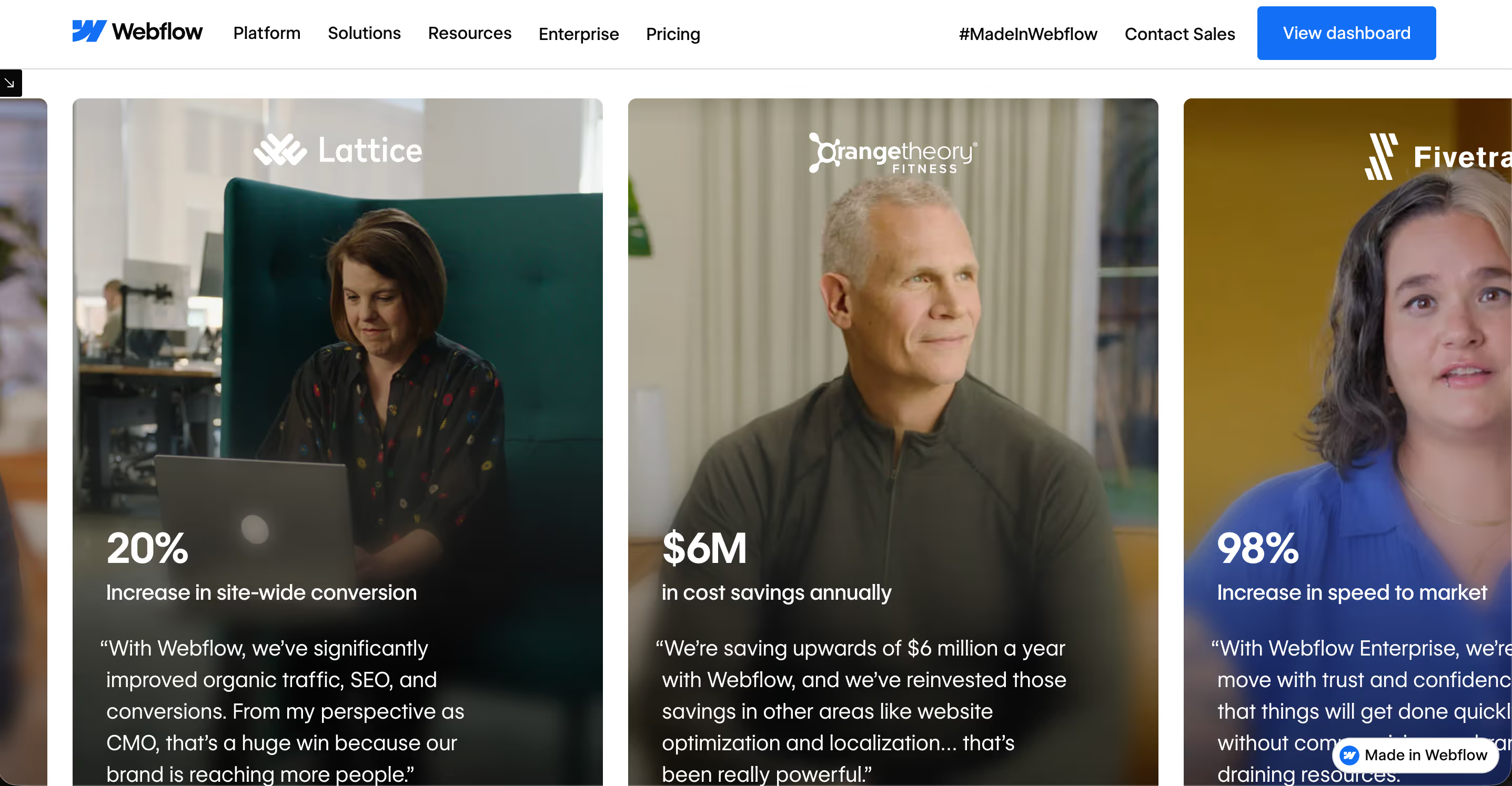
If we look at the new homepage, the contrast is striking. Previously, the focus was on beautiful animations and the 'wow' factor. Now, all essential information is present directly in the code, upon loading. It includes an explicit positioning statement, quantified customer testimonials, and a clear presentation of target audiences: marketing, design, engineering teams, and agencies.
These customer figures are a golden signal. When an AI scrapes the homepage and reads that Orangetheory saved $6 million annually, or that Lattice achieved a 20% conversion increase across its entire site, it has concrete, citable data. Unlike a site bogged down with JavaScript, a streamlined page with readable code and fact-rich content is exactly what an AI looks to extract.
The second pillar is the most subtle, and arguably the most strategic. The perception gap is the difference between how AI describes your company and how you would describe yourself.
Webflow provides a very concrete example from its own experience. When its teams started checking how AI presented the brand, it was consistently described as a simple "no-code website builder." A description not inaccurate given Webflow's origins, but completely outdated compared to its current positioning as an agentic web platform for demanding brands.
The mechanism is important to understand. An AI synthesizes its responses from signals scattered across the web: your homepage, third-party reviews, Reddit threads, YouTube, Wikipedia, and publications that mention you. Your homepage is just one input in a much broader consensus, but it's a critical input. If your site's structure doesn't clearly state who you are, what you do, and who you serve, AI will fill in the gaps with whatever it finds most readable elsewhere. Reducing this gap means regaining control of the narrative.
The third pillar is by far the most difficult to implement, even for agencies. Once the information is controlled, the challenge becomes measuring what is actually being said in AI responses. Webflow structures this measurement into three layers.
The first layer, visibility, tracks how the brand appears in AI-generated responses for a set of priority prompts, and verifies if the tone and message align with reality. The second layer, citations, measures whether the brand is referenced as a source, and not just mentioned in passing. The third layer, business impact, check if visitors from AI actually sign up and convert.
This end-to-end tracking, from AI to conversion, is the major technical challenge for AEO today. As Webflow itself acknowledges, this area doesn't yet have perfectly clear answers.
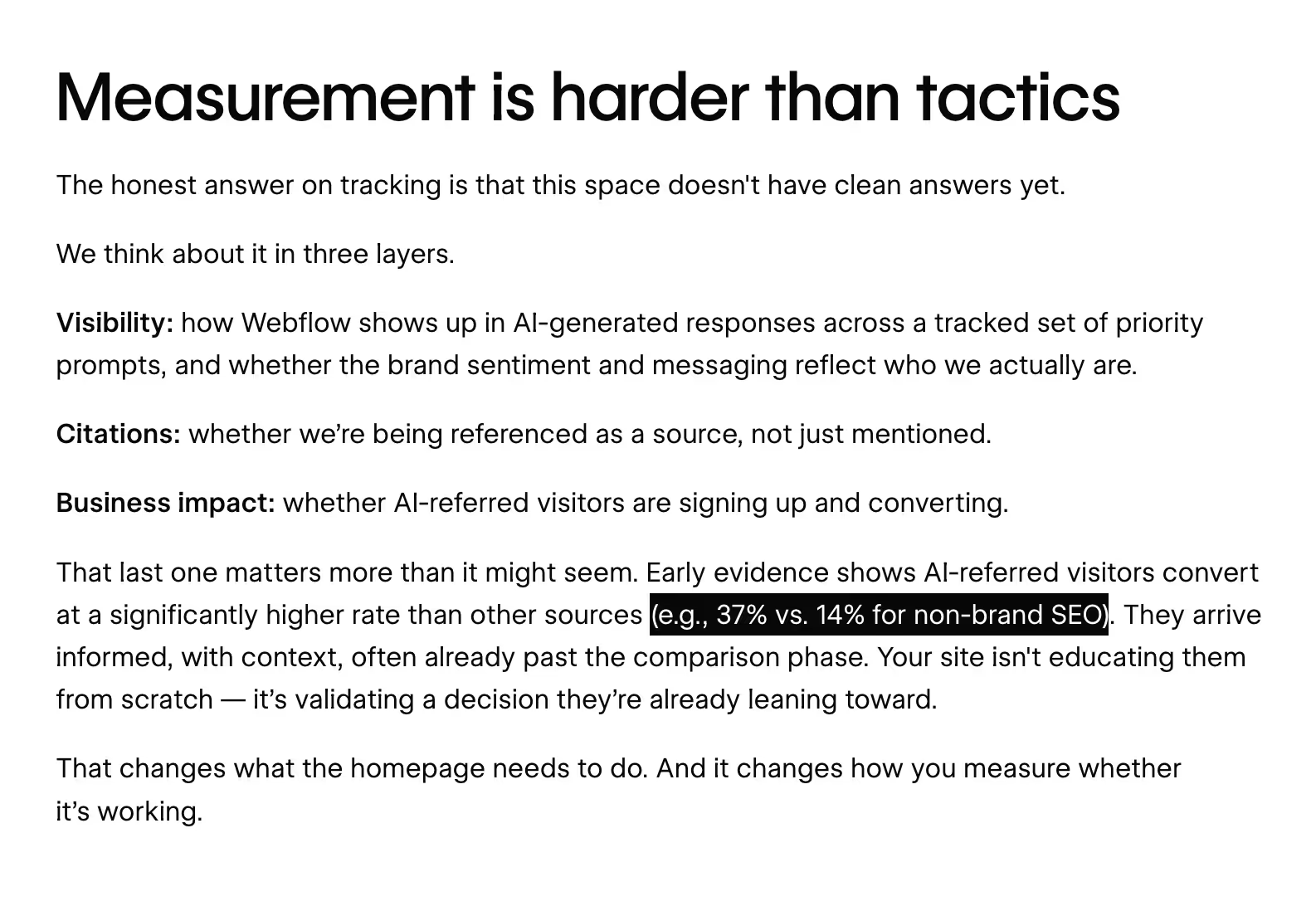
This is the data that justifies the entire investment. Webflow observes that visitors from AI convert at 37%, compared to 14% for non-brand organic search traffic. An increase of more than 2.6 times in the conversion rate.
The explanation lies in the very nature of these visitors. They arrive informed, with context, often already past the comparison phase. When ChatGPT presents Webflow, it highlights its strengths, use cases, and limitations. The user who then clicks no longer needs to be educated from scratch: your site merely validates a decision they are already leaning towards. This changes what the homepage needs to accomplish, and how to measure if it's working.
Beyond strategy, here are the precise technical actions implemented, all directly transferable to your own site.
This last point is worth emphasizing. Many players oversell llms.txt as the miracle AEO solution. Webflow observes the opposite, and we concur with this finding in practice: code quality, data structure, and branding carry infinitely more weight.
Webflow's strategy is ambitious, but its principles can be applied to businesses of all sizes. Here are five actions we recommend to adapt it to your scale.
Go to ChatGPT, ask questions about your company, provide your website link, and ask what it understands from it. You'll immediately see if the AI accesses the correct information or if your site's structure creates a gap between your actual positioning and what is conveyed.
Key figures, testimonials, concrete evidence. Every company has data to leverage, even non-numerical data. Also highlight your teams and your human aspect, as this signals to the AI that you are a real and identifiable organization.
Lightweight code, content present on load, JavaScript reduced to the bare minimum. This is precisely what Webflow is natively optimized for in terms of AEO, making it an ideal platform for this type of strategy.
Schema markup allows AI to unambiguously identify the nature of your pages, your organization, and your content authors. Again, Webflow natively integrates this structured data, without complex development.
This is the most important point, for both SEO and AEO. Webflow is ubiquitous on Reddit, continuously updates its blog, and hosts numerous webinars and partner events. The more you are talked about, the more you are cited, the more visible you become, both in real life and to artificial intelligences.
The central lesson from this case is that AEO is not an isolated technical optimization, but rather the convergence of code, factual content, and branding. Webflow didn't become the AI benchmark by simply checking technical boxes. It achieved this by building a brand whose existence artificial intelligences can no longer ignore. This clearly proves that branding trumps market share.
Webflow frames it as a closed loop. You observe how AI perceives you, adjust your structure, measure what has changed, and then repeat the process. And as the company emphasizes, the window to define this perception within your category is narrow: if you don't shape how AI describes you, someone else will do it for you.
For most B2B companies, the journey begins with the first two actions: auditing the perception gap and rewriting content with results in mind. This is exactly the approach we apply in our SEO & AEO agency.
We audit your perception gap and optimize your site to be readable and citable by ChatGPT, Claude, Gemini, and Perplexity. The AEO audit is complimentary.
Book a call with Amaury or contact us via the contact page.