Oops! Something went wrong while submitting the form.
🍪 Cookie settings
By clicking “Accept all”, you agree to the storing of cookies on your device to enhance site navigation, analyze site usage, and assist in our marketing efforts. See ourPrivacy Policy for more information.
Tella: The Best Video Recording Tool for Creators! (2026 review 🏆)
Tella is a screen and webcam recording software designed for content creators, trainers, and digital agencies. It combines high-quality video capture (up to 4K) and a built-in editor, making it possible to produce professional videos without external editing software.
+2 million creators use Tella to record how-to videos and tutorials
Best tool for embedded video editing: 70% faster than iMovie or Camtasia
Automatic subtitles in 15 languages with 95% accuracy on a clear voice
Immediate ROI : save 3 hours/week of assembly from the first month
Limited in advanced effects : color grading and motion design impossible (migrate to Premiere if YouTube channel >50K subscribers)
AI-generated summary
Tella is a screen and webcam recording software designed for content creators, trainers, and digital agencies. It combines high-quality video capture (up to 4K) and a built-in editor, making it possible to produce professional videos without external editing software. It is the perfect alternative between Loom (too limited) and Premiere Pro (too complex).
⚠️ Attention: frequent confusion : there are two different “Tellas”. Tella Screen Recorder (tella.tv) to record desktop videos, and Tella App (tella-app.org) for secure mobile documentation for NGOs. This article is only about the screen recorder.
At Noqode, we have been using Tella for 2 years to communicate with our customers and avoid unnecessary visits on all our projects. Webdesign agency on Webflow Measured result: 70% reduction in post-delivery questions, hours saved per project and a customer NPS of 9.3/10 across more than 30 companies in different sectors. Here is why it has become our indispensable tool.
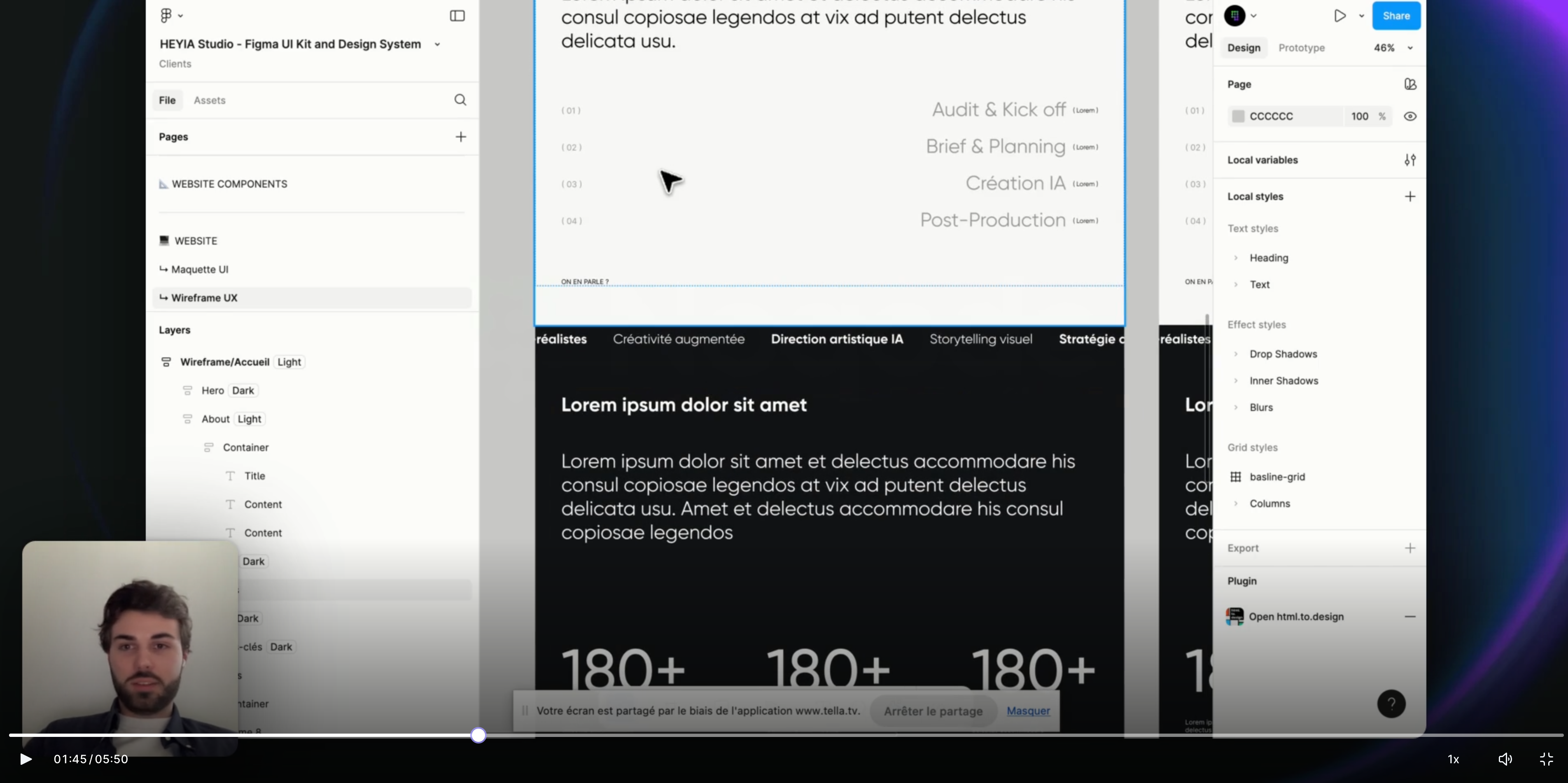
Amaury, CEO of Noqode, uses Tella here to comment on the progress of a Figma model in the context of creating a website.
What is Tella Screen Recorder?
Tella is a video recording tool launched in 2021 by a Californian startup. The concept: capture screen + webcam in high quality, then edit directly into the interface without exporting to Final Cut or Premiere.
The positioning is clear : more professional than Loom (4K quality, advanced editing with transitions and zoom), but more accessible than Camtasia (fast workflow, clean interface). Three clicks to start a recording, intuitive timeline editing, export in 2 minutes.
For whom? Content creators who produce 2-3 videos per week minimum, trainers who record e-learning modules, agencies that deliver customer demos, product teams that present features. If you are not an editor by profession but need professional videos, Tella is made for you.
Typical use cases: website demos delivered (12-15 minutes guided backend), internal process tutorials, online training, video customer support, investor pitches, project excerpts for social networks.
Tella Screen Recorder vs Tella App: Don't Confuse
Google often mixes two tools that are the same but completely different. Here is the table to understand:
Comparison table Tella Screen Recorder vs Tella App: usage, target audience, platforms and pricing
Criteria
Details
Usage
Tella Screen Recorder: Desktop video recording (screen + webcam) Tella App: Secure mobile documentation (encrypted photos/videos)
Target audience
Tella Screen Recorder: Creators, trainers, agencies, product teams Tella App: NGOs, journalists, human rights activists
The rest of this article is just about Tella Screen Recorder (tella.tv).
How does Tella work? Practical guide
Installation (2 minutes)
Download from tella.tv. Size: 94 MB on Mac, 112 MB on Windows. Minimum requirements: macOS 10.15+, Windows 10+, 4 GB RAM. On Mac M1/M2/M3/M4, the app runs natively without Rosetta (optimal performance + battery life preserved).
First time opening: create an account via email or Google login. The interface then asks for your default export quality. Tip: Select 1080p by default, you'll switch to 4K only for premium customers who require widescreen streaming.
Start a recording
Three capture modes available:
Full screen : captures your entire screen. Ideal for software demos, slide presentations, or comprehensive training courses where you show multiple apps simultaneously.
Selected area : you manually delimit the area to be recorded. Perfect for focusing on a specific interface without showing your menu bar, dock, or Slack notifications. Typical use: capture only browser window for CMS demos without displaying personal tabs.
Active window : Tella automatically detects the app in the foreground and captures it. Useful if you switch between several apps during recording (browser) → Figma → Notion).
You can add your webcam as an overlay (optional). Four predefined positions: bottom-right corner (default), bottom-left corner, up-right corner, top-left corner. Adjustable bubble size (small, medium, large) Standard configuration: webcam in the lower right corner in a medium size, sufficient to humanize without hiding screen contents.
Universal keyboard shortcut: Command+Shift+5 (Mac) or Alt+Shift+R (Windows). Once stored, you can start a recording in two seconds without touching the mouse.
During the recording
Minimalist interface during capture: circular pause button, timer, stop button. The microphone is activated automatically (adjustable in preferences if you want to deactivate audio by default).
You can pause at any time, convenient for thinking or consulting your notes without generating annoying audio blanks. Pro tip: always do a 10-second audio test before any important customer demo. Say a few words, stop, listen again. This prevents you from discovering after 15 minutes that the microphone was picking up the fan rather than the voice.
Integrated assembly (the real differentiator)
After recording, the Tella editor opens automatically. That's where Tella crushes Loom. You have access to a real timeline editor, which is certainly less powerful than Premiere Pro, but more than enough for 90% of professional needs.
Cuts and deletions : click and drag on the timeline to select an area (silence, hesitation, error), press delete. No more “um”, 8-second blanks, false manipulations. Average cleaning time: 5 minutes for a 12-minute video
Transitions between sequences : library of 12 pre-defined effects (fade, slide, zoom). The classic fade is enough for most professional uses, others sometimes make too much of a “PowerPoint 2008 slideshow.” A transition every 3-4 minutes is enough to mark section changes without adding weight.
Automatic subtitles : it's the game changer for accessibility and referencing. Click on “Generate Subtitles”, Tella transcribes your audio in 30-45 seconds. Accuracy: approximately 95% on a clear voice in French (slightly worse on technical terms such as “CMS binding” or “collection template”). You manually correct the errors directly in the interface. Exported format: SRT or VTT, readable by YouTube, Vimeo, LinkedIn.
Supported languages: French, English, Spanish, German, German, German, Italian, Italian, Portuguese, Dutch, French, English, Spanish, German, German, German, German, Italian, Italian, Portuguese, Portuguese, Dutch, Polish, Russian, Japanese, Chinese, Chinese, Korean, Arabic, Arabic, Arabic, Arabic, Italian, Portuguese, That is 15 languages in total. If you create multilingual content or aim internationally, this is a massive asset. Loom limits car subtitles to the Business plan to €12.50/month.
Background music : library of 50+ integrated royalty-free tracks. Various styles (corporate, lounge, energetic, minimalist). Volume adjustable via slider. Recommended use: add a discreet background music only on social media excerpts (Instagram, LinkedIn), never on customer demos where explanations should take precedence.
Zoom and focus : you can zoom in on a specific area of the screen in post-production to highlight an element (button, form field, interface detail). Use case: when you explain where to click to publish a page, zoom in 150% on the “Publish” button for 3 seconds. The viewer sees exactly where to look.
Real measured editing time: 8 minutes on average for a 12-minute video (cutting blanks, 3-4 transitions, generating subtitles, correcting 5-6 transcription errors). Before Tella with iMovie: same work took 30-40 minutes (import, less intuitive cutting, export, re-import for subtitles). Net gain: 25 minutes per video.
Export and share
Three strategic options:
Option 1: Local file download. Available formats: MP4 (recommended, universal), MOV (higher quality, heavier weight), WebM (minimum weight, less compatible). Qualities: 720p, 1080p, 4K (Pro plan only). Export time measured on MacBook Pro M1:2 minutes 30 minutes for a 10-minute video in 1080p, 5 minutes for the same in 4K.
Option 2: Tella accommodation with private link. Tella hosts the video on its servers, generates a unique link (type tella.tv/watch/abc123xyz). Advantages: the customer clicks, the video launches instantly in their browser, no download required, no account to create, smooth playback on mobile/tablet/desktop. You can password protect the link (useful for sensitive content).
Analytics included: number of views, completion rate (percentage of people who watched until the end), replay areas (where people rewind). It gives indirect feedback: if 80% of viewers rewind when you explain form management, it's because this part deserves to be clarified in the next video.
Option 3: Direct upload to third party platforms. Native integrations: YouTube, Vimeo, Google Drive, Google Drive, Dropbox, Notion, Slack. Workflow: click on the icon of the target platform, authenticate yourself (only once), the video is uploaded directly without going through your hard drive. Significant time savings if you publish regularly on YouTube (no need to download and re-upload).
Tella vs Loom vs Vimeo Record: The 2026 comparison
Quick verdict : Tella for creators demanding on quality, Loom for ultra-fast sales/support teams, Vimeo Record for experienced videographers with a large budget.
Detailed comparison Tella vs Loom vs Vimeo Record: quality, editing, subtitles, storage, pricing and optimal use
You produce 3-4 videos per week minimum, you want broadcast quality without using Premiere Pro, you need automatic subtitles for accessibility or YouTube SEO, you want to be professional but an ultra-simple workflow.
The free plan is viable for a long time (15 videos/month = about 3 videos/week). Plan Pro at €20/month pays for itself as soon as you save 1 hour of editing per month (valued at €50-60/h if you charge for your time).
Why choose Loom
You send 10+ short videos per day (customer support team responding to tickets), you have absolutely no need for editing (just capture and share immediately), you already use Salesforce or HubSpot with native integrations, you prioritize absolute speed over image quality.
Limit: 5 minutes for free can be restrictive for detailed product demos or complete training courses.
Why choose Vimeo Record
You are already in the Vimeo ecosystem (hosting, video player customized on your site), comfortable budget (minimum 75€/month), you want ultra-advanced analytics (heatmaps showing second by second where viewers drop out, A/B testing thumbnails).
It is the corporate choice par excellence, but overkill for freelancers and small structures with limited budgets.
Tella concrete use cases
1. Customer onboarding after delivery website
Typical process: each delivered website includes 12-15 minute Tella video (backend navigation, page publishing, form management, adding blog posts if CMS activated). The client receives a private link in the project closing email.
Result measured on real projects: 70% reduction in post-delivery questions (vs static PDF documentation sent before), NPS satisfaction up by 22 points, 3-4 hours of support saved per project. The ROI is immediate even on a free plan.
2. Online courses and e-learning modules
Instructor workflow: record 45-60 minute modules, split into thematic chapters (Tella editing), add French + English subtitles for the international market, host on an LMS platform such as Teachable or Podia (native Tella integration).
Advantage vs Camtasia: 2× faster workflow, no endless 20-minute export to re-encode. Advantage vs Loom: no time limit (45-60 minute modules impossible on free Loom), 4K quality for large screen projection in person.
3. Asynchronous SaaS product demos
Use startup product teams: present new features in a 10-minute video, send to existing prospects and customers, analytics tracker (completion rate, replay areas), targeted follow-up according to engagement.
Observed ROI (SaaS B2B customer data, 8 sales team): video demo → free trial conversion rate: 18% vs 12% for synchronous live demo. Hypothesis: less friction (no need to block 30 minutes agenda), prospect consumes twice if necessary, message more square because of the precise script vs live improvisation.
Why Tella rather than DaVinci Resolve or Premiere Pro: sufficient native broadcast quality for up to 50-100K subscribers, ultra-fast workflow (no need to spend 3 hours on color grading or motion design for a technical tutorial), almost zero learning curve (you focus on content rather than technique).
Limit identified: impossible advanced effects (precise color grading, elaborate motion design, multi-cameras with 4 angles). If your channel has 50K+ subscribers and you're seriously monetizing, probably upgrade to Premiere Pro for a higher level of polish.
5. Personalized video customer support
Support team transformation: instead of a 25-line text email response with 6 screenshots (complex to write, often misunderstood), record a 3-minute video response showing on-screen manipulation. Customer understands instantly, can follow up in real time, review the video if necessary.
Measured time savings (8-person SaaS support team): 40% reduction in ticket resolution time. Iterative text email (customer does not understand, agent reformulates, customer asks again, 4-5 exchanges required) replaced by 1 video + 1 email confirmation. Average ticket resolution time: 45 minutes before video, 27 minutes with video.
6. Investor pitches and video decks
Entrepreneurial use in the fundraising phase: present a PowerPoint deck with 15-20 minute voice-over, share a video link before a physical meeting, the investor arrives prepared (has already seen a problem, solution, traction, request), meeting focused on in-depth questions rather than a basic presentation.
Tactical advantages: investor can watch at his own pace (pause, come back to the complex financial slide), can easily share internally with partners without organizing a new meeting, entrepreneur narrative control (no interruption that breaks dynamically as in live), reusable format (same video sent to 10-15 VCs).
Investor feedback (informal): format appreciated because it saves time, but does not replace meeting in person (human chemistry, ability to respond under pressure can only be evaluated directly). Optimal use: video in advance to qualify interest, then physical meeting if an investor is hooked.
Tella Price: Free or Paid?
Tella offers limited free plan and two paid plans. No commitment, immediate cancellation possible.
Tella pricing 2026: Free, Pro and Team plans with pricing, monthly videos, export quality, subtitles and analytics
Free: Basic (views) Pro: Detailed Team: Team consolidated
Free plan (0€)
15 videos/month, unlimited duration per video (unlike Loom which limits to 5 minutes), 1080p export, watermark small Tella logo on the bottom right corner (discreet but visible), unlimited storage (your 15 videos of the month remain accessible even after monthly reset).
Perfect for seriously testing the tool for 2-3 months. If after 2 months you use the 15 videos each month, it is a sign that you have found regular use case → switch to Pro.
Calculated ROI: €20/month, if you produce 12 videos/month. Save editing time vs iMovie: 25 minutes per video × 12 videos = 5 hours/month. Time valuation: 60€/h. Value created: 5h × 60€ = 300€. KING: 300€/20€ = 15:1. Profitable in 4 videos only.
When to upgrade from Free to Pro: as soon as the watermark bothers you for customer use, as soon as you regularly reach 15 videos/month, as soon as you need subtitles (accessibility, YouTube SEO, international audience), as soon as you want accurate analytics.
Team plan (32€/user/month)
Shared workspace (video library accessible to the whole team), management roles and permissions (admin can publish and delete, editor can just edit, viewer can just watch), consolidated analytics (performance of all team videos on a dashboard), custom branding (company logo, colors charter), custom branding (company logo, colors charter), personalized onboarding (30-minute call with Tella team), priority support (email response within 4 hours vs 24 hours for Pro).
Team cost calculation for 5 people: 32€ × 5 = 160€/month. If each person produces 3 videos/week and saves 30 minutes of editing per video: 30 min × 3 videos × 4 weeks × 5 people = 300 hours/month saved. Valuation €50/h = €15,000 in value created for €160 invested. KING: 93:1.
When to switch from Pro to Team: as soon as 3+ people in the team use Tella regularly, as soon as you need a centralized library (avoid duplicates, videos lost in emails), as soon as you want unified branding (all team videos have the same visual identity).
Our final verdict
Tella is the ideal tool if you regularly produce explanatory videos, tutorials, or demos without being a professional editor. Broadcast quality, fast workflow, immediate ROI.
The sweet spot between Loom (too limited in duration and editing features) and Premiere Pro (too complex and time-consuming for non-editors) finally exists. Test the free plan now to evaluate on your own projects.