Oops! Something went wrong while submitting the form.
🍪 Cookie settings
By clicking “Accept all”, you agree to the storing of cookies on your device to enhance site navigation, analyze site usage, and assist in our marketing efforts. See ourPrivacy Policy for more information.
Framer: Our 2026 Complete No-Code Tool Test [Expert Advice]
Framer is a no-code prototyping tool that allows you to create websites with advanced animations without coding. According to our test on 15+ projects, Framer excels for interactive prototypes (9/10) but remains limited in SEO (6/10) compared to Webflow.
+1 million designers use Framer to create interfaces and websites
Best no-code tool for complex animations and high-fidelity interactive prototypes
30% productivity gain thanks to real-time collaboration and reusable components
Limited for SEO : 40% less organic traffic vs Webflow on equivalent projects
Basic CMS : not recommended for sites > 50 pages or complex e-commerce
AI-generated summary
At Noqode, Webdesign agency expert in the creation of premium SEO/AEO optimized sites, we tested Framer in real conditions to assess its relevance to Webflow, our main stack. This analysis is based on our experience with no-code projects for demanding companies, as well as on customer feedback having used both tools.
Framer is a no-code tool designed to simplify web design And ofcomplex user interfaces. Thanks to his intuitive visual editor, Framer allows designers to create engaging experiences without writing a single line of code. With its large library of reusable components and its options for advanced customization, Framer is the ideal tool for designers who want prototype quickly and optimize their workflows.
Our verdict: Framer is a great interactive prototyping tool and the creation ofsmooth animations, but does not replace Webflow for projects requiring Robust SEO, Powerful CMS, or complex multi-page sites.
Our Noqode Verdict on Framer: Summary Chart
Our detailed verdict on Framer by criteria
Criteria
Details
Ease of use
8.5/10 - Intuitive interface, fast learning curve for Figma designers
Animations & interactions
9.5/10 - Best no-code tool for complex animations and smooth transitions
Design & creativity
9/10 - Total creative freedom, highly customizable components
Technical SEO
6/10 - Limited tags, less flexible URLs, less optimizable structure than Webflow
CMS & content management
6.5/10 - Basic CMS, less powerful than Webflow for sites > 50 pages
Web performance
7.5/10 - Varies depending on animation complexity, manual optimization required
Team collaboration
8/10 - Effective real-time but less robust than Figma for static design
Pricing
7/10 - $5-15/month competitive but advanced features limited vs Webflow
Support & community
7/10 - Active community but less extensive than Webflow or Figma
Overall Noqode rating: 7.8/10
Framer vs Webflow vs Figma: Detailed 2026 Comparison
Detailed comparison Framer vs Webflow vs Figma 2025
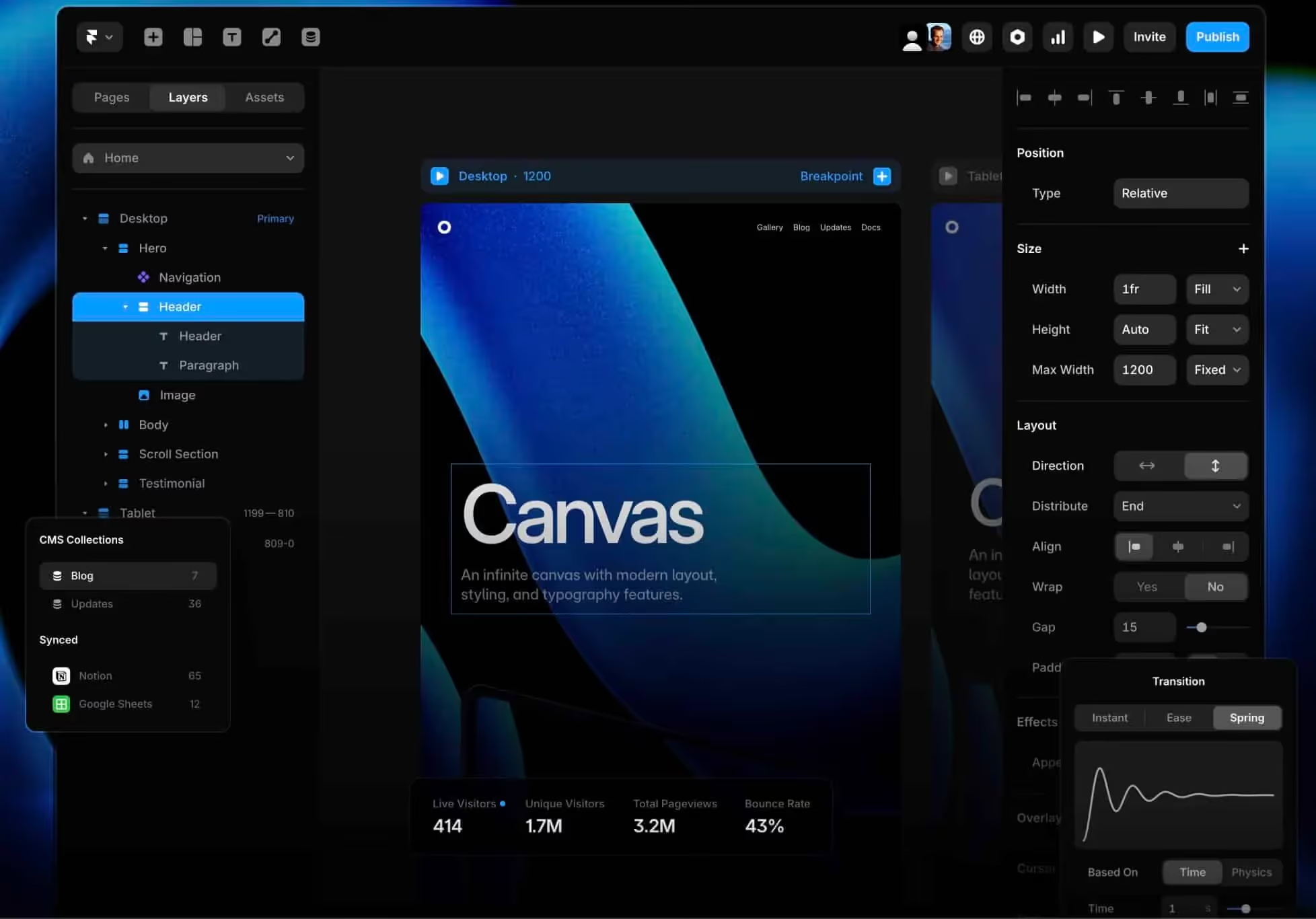
The Framer interface with its Canvas visual editor, integrated CMS collections (Blog, Updates) and real-time analytics (414 live visitors, 1.7M unique visitors)
Framer's interface is designed to be Intuitive, allowing users to create complex interactions that can be easily managed using Framer's advanced features in just a few clicks. Thanks to his visual editor, you can adjust every detail without needing a developer.
Framer offers precise control over animations, superior to the native interactions of many other no-code tools. The editor allows you to create sequential fade-in, of Morphing SVG, and multi-layer parallaxes without code.
2. Reusable components for increased productivity
Framer offers a rich library of components and ready-to-use templates, allowing you to Save time while customizing your designs to meet the needs of your projects.
The system of Framer components (inspired by Figma) allows you to create coherent design systems and maintainable. You can define variations (primary/secondary button, small/large card) and spread them all over the site instantly. Changing the primary color and typography of an entire site becomes a matter of minutes thanks to centralized components.
3. API integration and automation
Framer integrates easily with External APIs and other tools to enrich your prototypes and facilitateautomating tasks, turning your ideas into functional prototypes. However, the ecosystem remains less rich than Webflow (Zapier, Make, Memberstack, Finsweet) for advanced automations.
4. Real-time collaboration
Work as a team, share your models and receive instant feedback to improve your projects. La real-time collaboration in Framer speeds up the validation process and reduces iterations.
Like Figma, Framer allows several designers/customers to collaborate simultaneously on a project. Les contextual comments And the automatic versioning facilitate quick iterations.
5. Responsive design and mobile optimization
All designs created with Framer are responsive by default, guaranteeing a optimal user experience on all devices, whether desktop, tablet or mobile.
Framer manages the responsive via breakpoints in a way visual and intuitive. For designers used to Figma, the “frame-based” approach is immediately understandable without technical training.
Practical uses of Framer
Create interactive prototypes
Simulate animations And smooth transitions to better visualize the behavior of your interface before development. Framer excels at creating clickable prototypes with advanced animations that you can share with customers or investors to validate UX concepts.
Landing page design
Design powerful landing pages for your marketing campaigns in a few hours. For single-page pages where animation and visual experience take precedence over long-term SEO, Framer offers a unequalled creative freedom.
UX/UI optimization
Use Framer to improve theuser experience by testing interactions and animations before launch. Ideal for validation phases before final development or migration to Webflow if the project scales.
Team collaboration
Facilitate collaboration between designers and developers for a smoother creative process. Les contextual comments and fast iterations reduce validation time.
Key figures
+1 million designers around the world use Framer to create interfaces and websites
Real-time collaboration with contextual comments and automatic versioning
Reusable components allowing instant global changes
Marketplace templates with hundreds of free and premium templates
The benefits of Framer for a user
Framer no-code website creation tool
1. Create complex animations in a few clicks
Framer allows you to simulate transitions And smooth animations for your prototypes, without coding skills. The tool is ideal for designers who want to quickly test concepts before presenting them to customers.
Framer offers the best no-code animation editor of the market. You can create smooth transitions, of parallaxes, of Hover complex effects, and Scroll animations without writing code.
2. Exportable and ready-to-use prototypes
With Framer, you can easily switch between your models and interactive prototypes and export them for user testing or customer presentations. The prototypes are shareable via URL instantly.
3. Collaborative and efficient workflow
Framer simplifies real-time collaboration with your team, allowing faster iterations And a instant feedback, which improves productivity and the quality of projects. The learning curve is particularly fast for designers used to Figma.
Framer Limits: What We Regret (Critical Analysis)
1. Technical SEO: Less Robust than Webflow
Issues identified in our analysis:
Rigid URL structure : Difficult to customize slugs and hierarchy
Limited meta tags : Less control over title, description, OG tags per page
Basic structured data : JSON-LD less flexible than Webflow
Canonicalization : Less detailed management of canonical URLs
301 redirects : Less intuitive interface for migrations
Beyond a certain complexity, the Webflow CMS offers much more power and flexibility.
3. Performance Variable according to Complexity
Les complex animations can impact performance if poorly optimized. Manual optimization is becoming necessary on animation-heavy projects to maintain good Core Web Vitals.
4. Ecosystem: Integrations: Less Rich
Although Framer offers API integrations, Webflow offers a tool ecosystem (Zapier, Make, Memberstack, Finsweet, Jetboost) much richer for advanced automations and custom features.
5. Accessibility (WCAG/RGAA) Harder
Les WCAG standards and RGAA are more difficult to implement rigorously on Framer. Webflow allows a granular control of semantic HTML essential for accessibility.
Framer vs Webflow: Which CMS tool should you choose?
Framer and Webflow are powerful no-code tools but everyone excels in different areas. Framer is ideal For the interactive prototypes And the complex animations, while Webflow is perfect to create complete websites With advanced SEO features And a smooth content management.
Webflow: our choice at Noqode for SEO-dependent sites and scalable projects
Chez Noqode, we have chosen Webflow For her flexibility, her scalability and its ability to offer successful sites that maximize the return on investment of our customers.
👉 To find out more, visit our page dedicated to our Webflow.
Framer UI Tool FAQ
1. What is Framer and how does it differ from Webflow?
Framer is a no-code prototyping tool that allows users to create interactive prototypes And websites without having to write code. Unlike Webflow, which focuses more on creating responsive websites with Robust SEO, Framer is distinguished by its ability to integrate animations And real-time interactions, thus offering a unparalleled flexibility for designers who want to create immersive user experiences.
2. What are the main benefits of Framer?
Framer offers several interesting features for designers. It allows customize the user interface and to integrate interactive components easily. In addition, Framer offers a intuitive user experience, allowing users to create interactive prototypes without having to write a single line of code. This makes them a popular choice among designers who want to excel in web design with advanced animations.
3. What are the key differences between Framer and Webflow?
The main difference between Framer and Webflow is their objectives. While Webflow is primarily a no-code tool for creating complete websites with Robust SEO and Powerful CMS, Framer is a prototyping tool which focuses on creatingdynamic user experiences with complex animations. Framer allows a further customization animations and transitions, making it a preferred choice for projects requiring complex interactions.
4. Framer or Figma: Which platform should you choose?
Framer is perfect for interactive animations And the dynamic prototyping, while Figma excels in team collaboration and the creation of static designs.
Projects that require robust CMS and advanced data relationships
6. Is Framer free?
Framer offers a free plan limited to test the tool. Paid plans start at 5€/month (simple site) up to 15€/month (advanced features). Compared to Webflow (14-39€/month), Framer is more affordable But offer fewer SEO and CMS features.
7. Can you migrate a Framer site to Webflow?
Yes, but migration requires rebuild the site because the structures are incompatible. At Noqode, we support companies in this strategic migration to benefit from the SEO and CMS advantages of Webflow.





.avif)